
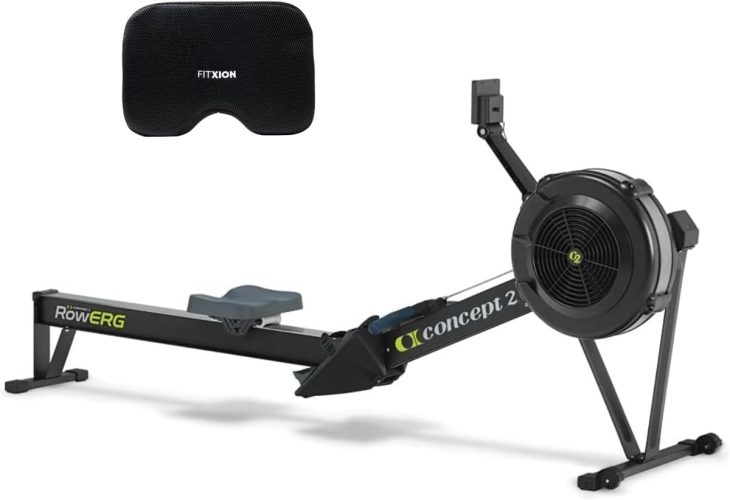
There is no serious argument about the best indoor rowing machine, which is unusual in fitness equipment. The Concept2 RowErg is what national rowing teams train on, what CrossFit competitions use, and what world records are set on. It has been refined rather than redesigned for decades, it looks industrial rather than sleek, and it has no subscription. At $1,299.99 for the version with the FitXion seat cushion, it costs less than most connected exercise bikes and will outlast all of them. The interesting question is not whether it is good — it is whether a rowing machine is the right purchase for you at all.
Reviews Universe is reader-supported. When you buy through links on our site, we may earn an affiliate commission at no extra cost to you.
The Short Version
Rating: 9.4/10
Best for: Anyone who wants a full-body, low-impact cardio machine they will still own in twenty years
Price: $1,299.99 (from $990 for the standard configuration)
Verdict: The benchmark, and not by a small margin. No subscription, accurate comparable data through the PM5 monitor, splits in two for storage, and a resale value that means owning one costs remarkably little. Needs 9 by 4 feet of floor space and rewards learning proper technique.
Concept2 RowErg Overview
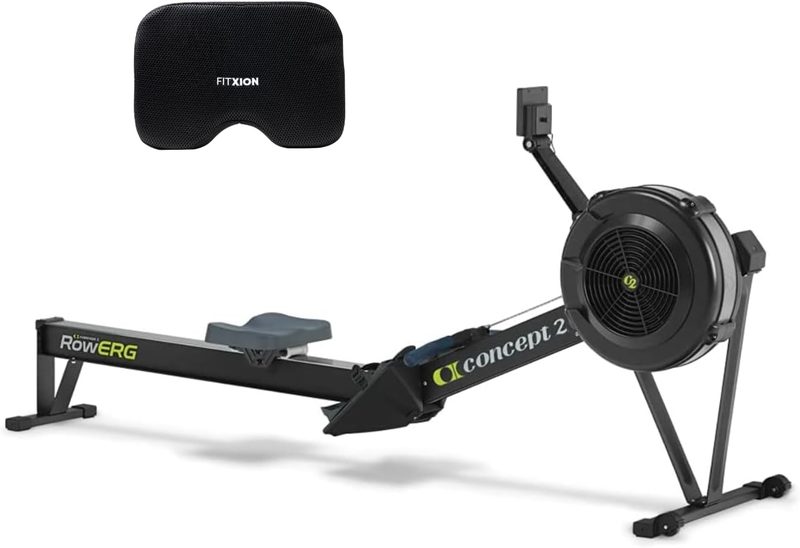
The RowErg is an air-resistance rower. A flywheel spins as you pull, and the resistance you feel comes from the air it has to move — which means the harder you pull, the more resistance there is. This is fundamentally different from magnetic or hydraulic rowers, where resistance is set at a level and stays there. Air resistance matches the way rowing on water actually behaves, and it is the reason competitive rowers train on these rather than on quieter alternatives.
The damper on the side of the flywheel adjusts airflow, which changes the feel of the stroke — a lower setting feels like a lighter, faster boat, a higher setting like a heavier one. It is worth understanding that this is not a difficulty dial. How hard the workout is depends on how hard you pull, at any damper setting. This is the most common misunderstanding among new owners, who set the damper to 10 assuming it means “hard” and develop poor technique as a result.
The machine is built from aluminum front legs and steel rear legs, rated for users up to 500 pounds, with a 14-inch seat height that suits most people and adjustable footrests. Concept2 backs the frame with a 5-year warranty. It separates into two pieces for storage and rolls on caster wheels, which matters because the space recommended for use is 9 by 4 feet — more floor than most home equipment demands.
Concept2 RowErg Specs
| Concept2 RowErg | |
|---|---|
| Price | $1,299.99 (from $990 standard) |
| Resistance type | Adjustable air resistance |
| Monitor | Performance Monitor 5 (PM5) |
| Connectivity | Bluetooth and ANT+ |
| App compatibility | Over 40 apps |
| Heart rate monitors | Connects wirelessly |
| Device holder | Integrated, holds phone or tablet |
| Seat height | 14 inches |
| Footrests | Adjustable |
| Handle | Ergonomic |
| User capacity | 500 pounds |
| Frame | Aluminum front legs, steel rear legs |
| Storage | Separates into two pieces, caster wheels |
| Space required | 9 x 4 feet |
| Power | Two D cell batteries (not included); flywheel powers monitor during use |
| Warranty | 5-year frame |
| Subscription required | None |
The PM5 Monitor Is Why This Machine Wins
Almost every home cardio machine displays numbers. Very few display numbers that mean anything. The Performance Monitor 5 is the reason the RowErg occupies the position it does, and it comes down to one word in Concept2’s own description: comparable.
The PM5 measures the actual work done at the flywheel and reports it in standardized units — most importantly your split, the time it would take you to row 500 meters at your current effort. Because every RowErg in the world measures the same way, a 2:05 split on your machine in your garage means precisely what a 2:05 split means on a machine at an Olympic training center. Your numbers are comparable across machines, across years, and against every other person who has ever used one. No other category of home fitness equipment offers this, and it is why competitive results are recorded on these machines.
Practically, that means progress is measurable rather than felt. You can compare a 5,000 meter row today against one from eight months ago and know with certainty whether you have improved, because the measurement did not drift and the machine did not change. For anyone motivated by data, this is far more useful than an arbitrary “intensity score” that only exists inside one manufacturer’s app.
Connectivity is Bluetooth and ANT+, pairing with heart rate monitors and with over 40 compatible apps — including the popular rowing games and structured training platforms. The integrated device holder keeps a phone or tablet in place while you row. Crucially, none of this is required: the PM5 works completely on its own, with no account, no subscription, and no app. If Concept2 vanished tomorrow, the machine would keep working exactly as it does now, which cannot be said of most connected fitness equipment.
Power is a nice piece of engineering: two D cell batteries run the monitor, but during a workout it draws power from the spinning flywheel, which extends battery life dramatically. The batteries are not included.
The Workout
Rowing is one of the few genuinely full-body cardio movements. A proper stroke is roughly 60% legs, 30% core and back, 10% arms — the opposite of what most beginners assume, and the source of most bad technique. Done correctly it recruits the large muscles of the legs and posterior chain while driving your heart rate up, which is why it produces a high calorie burn per minute and why rowers have the physiques they do.
It is also low impact. Your feet never leave the footrests and there is no landing shock, so unlike running it puts almost no load through the knees, hips and ankles. For anyone with joint problems, carrying extra weight, or returning from injury, this is the main practical reason to choose rowing over a treadmill.
The learning curve is real but short. The sequence is legs, then body swing, then arms on the drive, and the exact reverse on the recovery — arms, body, legs. Most people can learn it in one session from Concept2’s own instructional videos, and the difference in both effectiveness and lower back comfort between good and bad technique is substantial. Rowing with a rounded back and pulling primarily with the arms is how people hurt themselves and conclude that rowing is not for them.
Noise is the other consideration. The flywheel design minimizes noise relative to other air rowers, but any air resistance machine produces a whooshing sound as the flywheel spins. It is not loud enough to prevent watching television, but it is more audible than a magnetic rower and worth considering in an apartment with neighbors below.
Pros and Cons
Pros
- The PM5 monitor produces accurate, standardized data comparable across every RowErg in the world
- No subscription, no account, no app required — the machine is fully functional standalone
- Air resistance scales with effort, matching how rowing on water actually behaves
- Full-body, low-impact workout that spares the knees, hips and ankles
- Bluetooth and ANT+ connect to heart rate monitors and over 40 apps
- Separates into two pieces and rolls on caster wheels for storage
- 500 pound user capacity and a 5-year frame warranty
- Exceptional resale value — used units routinely sell close to retail
- Built to last decades with minimal maintenance
Cons
- Requires 9 by 4 feet of floor space in use
- Air resistance is louder than a magnetic rower
- Proper technique must be learned or you risk lower back strain
- Industrial appearance that will not blend into a living room
- Two D cell batteries are not included
- $1,299.99 for this configuration, though $990 versions exist
Who Should Buy the RowErg
Buy it if you want one cardio machine for the next twenty years. This is the strongest case. The RowErg is not a trend, it does not depend on a company continuing to run a service, and the design has been stable for decades. Buy once.
Buy it if your joints cannot take running. A full-body cardio workout with essentially no impact loading is a genuinely rare combination, and it is the reason physiotherapists recommend rowing so often.
Buy it if you are motivated by measurable progress. Standardized splits mean you can prove improvement rather than guess at it, and compare yourself against a worldwide population using identical equipment.
Do not buy it if you cannot commit the floor space. 9 by 4 feet in use is a real requirement. It splits in two for storage, but a machine that has to be reassembled is a machine that gets used less.
Do not buy it if you want a guided, screen-led experience. The PM5 shows numbers, not instructors. If a class-based interface is what gets you to exercise, a connected bike or a rower built around a screen may genuinely serve you better despite being the worse machine.
Other Configurations
Concept2 RowErg standard (around $990) — The same machine and the same PM5 monitor at a lower price, without the bundled seat cushion. Mechanically identical, and the cheapest route to the exact same workout and the exact same data.
Concept2 RowErg Model E with tall legs (around $1,560) — Raises the seat height to 20 inches instead of 14, which makes getting on and off considerably easier. Worth the premium if you have limited mobility, knee problems, or are simply tall.
Frequently Asked Questions
Is the Concept2 RowErg worth the money?
Yes, and it is one of the few pieces of home fitness equipment where that answer is uncomplicated. There is no subscription, the PM5 monitor produces standardized data comparable to every other RowErg worldwide, and the machines routinely remain in service for decades. Resale value is exceptional — used units often sell close to retail — so the real cost of ownership is far lower than the purchase price suggests. It is the machine national teams and competitions use, at a price below most connected exercise bikes.
What damper setting should I use on a Concept2 rower?
Most experienced rowers use 3 to 5, and it is not a difficulty setting. The damper controls how much air enters the flywheel, which changes the feel of the stroke — lower feels like a light, fast boat, higher feels like a heavy one. How hard your workout is depends entirely on how hard you pull, at any setting. Setting the damper to 10 assuming it means maximum effort is the most common beginner mistake and tends to encourage poor technique.
Is rowing a good workout for weight loss?
It is one of the better options, because it recruits far more muscle mass than cycling or most machines — roughly 60% legs, 30% core and back, 10% arms in a proper stroke — which drives a high calorie burn per minute. It is also low impact, so people who cannot tolerate running can sustain it. As always, consistency matters more than the machine, but rowing combines high output with low joint stress better than almost any alternative.
How much space does a Concept2 RowErg need?
Concept2 recommends 9 by 4 feet for use. That is a genuine requirement rather than a guideline, since the seat travels the length of the rail and you need clearance behind you. For storage the machine separates into two pieces and rolls on caster wheels, so it can be stood in a corner between sessions, though a machine that must be reassembled each time tends to get used less often.
Do you need a subscription to use the Concept2 RowErg?
No, and this is one of its biggest advantages over connected fitness equipment. The PM5 monitor is fully functional on its own with no account, no app and no ongoing payment. It connects over Bluetooth and ANT+ to heart rate monitors and to over 40 compatible apps if you want them, but none of that is required. The machine will work identically in fifteen years regardless of what happens to any software platform.
Is the Concept2 RowErg loud?
It produces a whooshing sound as the flywheel spins, which is inherent to air resistance. Concept2’s flywheel design minimizes this relative to other air rowers, and it is not loud enough to stop you watching television or holding a conversation. It is, however, noticeably louder than a magnetic rower, which is worth considering in an apartment with neighbors below or if you plan to train early in the morning in a shared home.
Final Verdict
The Concept2 RowErg is the closest thing to an obvious purchase in home fitness equipment. It delivers a full-body, low-impact workout on a machine built to last decades, and the PM5 monitor gives you data that is genuinely accurate and genuinely comparable — against your own past performances and against every other person rowing on the same equipment anywhere in the world. There is no subscription, no account, and no dependence on a company continuing to support an app.
The trade-offs are honest and small. It needs 9 by 4 feet of floor. It makes a whooshing noise. It looks like gym equipment rather than furniture. And you have to spend twenty minutes learning to row properly, which you should do anyway.
Rated 9.4 out of 10. The one caveat worth repeating: if what actually gets you to exercise is an instructor on a screen, buy the machine that provides that instead. The RowErg is the better machine, but the best machine is the one you use. If you are self-motivated and want equipment that will still be worth owning in 2046, this is it — and the standard configuration around $990 gets you the identical workout for less.