
Getting your songs onto Spotify, Apple Music, TikTok and YouTube Music takes a distributor, and DistroKid and RouteNote are two of the most popular. They take opposite approaches. DistroKid charges an annual subscription and lets you keep 100% of your royalties. RouteNote is free: no upfront cost and no yearly fee, in exchange for 15% of what your music earns — with an optional Premium upgrade per release if you would rather keep 100%. That difference matters most on the day you stop paying. Here is how the two compare in 2026 on price, speed, features and what happens to your music long term.
Reviews Universe is reader-supported. When you buy through links on our site, we may earn an affiliate commission at no extra cost to you.
The Short Version
Choose RouteNote if you are starting out, release occasionally or simply don’t want another subscription. It costs nothing to release music and nothing to keep it online — forever.
Choose DistroKid if you release often, need music live within days on a set date, and your music already earns enough that 15% would cost more than a $24.99 subscription.
Our pick for most independent artists: RouteNote. We’ve used its free plan ourselves; it’s the safest way to put music out with no money down and no catalog held hostage to a yearly bill. Just plan your release dates well ahead.
DistroKid vs RouteNote at a Glance
| DistroKid | RouteNote | |
|---|---|---|
| Company | DistroKid LLC, New York, USA (since 2013) | RouteNote Ltd, Truro, Cornwall, UK (since 2007) |
| Price | $24.99/yr (1 artist), $44.99/yr (2), from $89.99/yr (Ultimate) | Free; Premium from $10 per release |
| Royalties you keep | 100% | 85% on Free, 100% on Premium |
| If you stop paying | Releases are taken down (unless each has Leave a Legacy, $29/$49) | Nothing to stop on Free; Premium releases move to Free and stay live |
| Review before release | Several days | 26-27 working days (Oct 2026); Fast Track on Premium |
| YouTube Content ID | Social Media Pack: $4.95/single per year + 20% of revenue | Free, included |
| Stores | 150+ platforms | Major stores incl. Spotify, Apple Music, TikTok, Amazon, YouTube Music, Tencent |
| Royalty splits | Yes, free | Yes, free (between RouteNote users) |
| Minimum payout | $6 | $50 |
| Unlimited releases | Yes | Yes |
| Trustpilot (Oct 2026) | 4.5/5 (about 42,000 reviews) | 3.2/5 (about 3,000 reviews) |
Pricing: Subscription vs Free
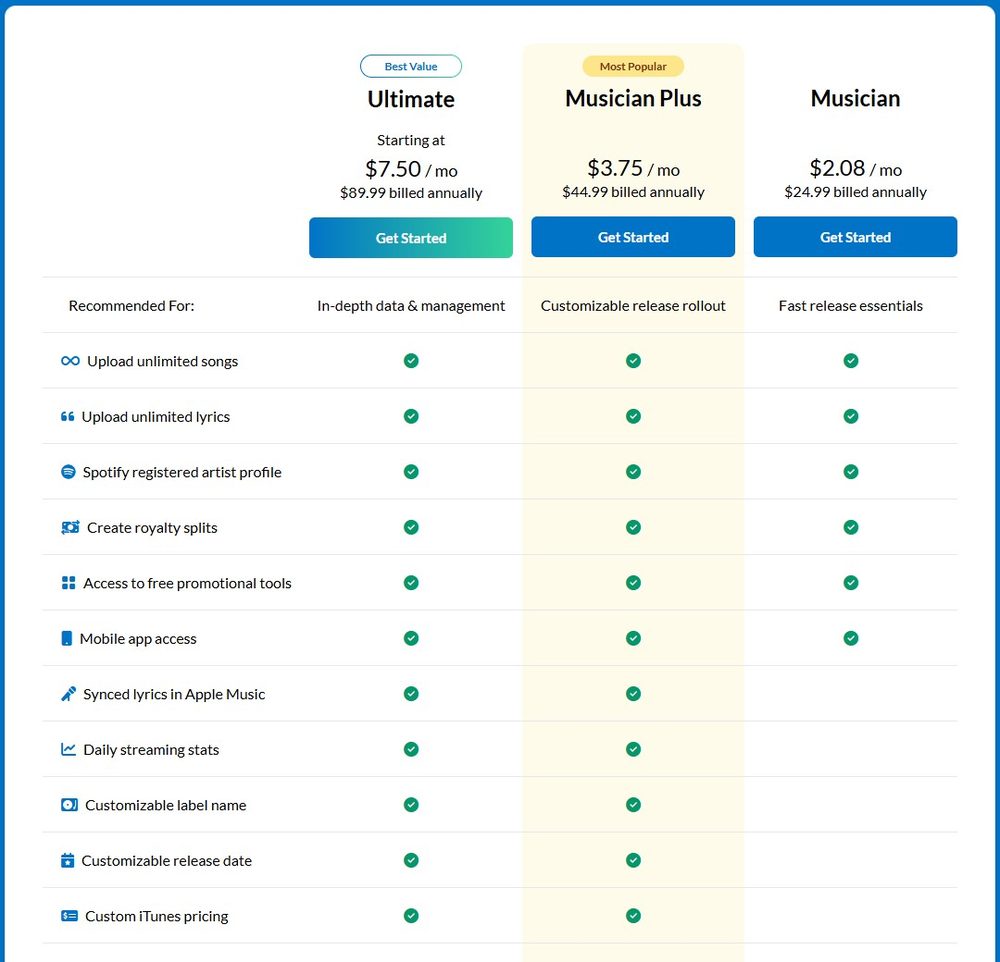
DistroKid sells three annual plans. Musician ($24.99 a year) covers one artist with unlimited uploads, royalty splits and a Spotify artist profile. Musician Plus ($44.99) covers two artists and adds a custom release date, label name, daily stats and synced lyrics in Apple Music. Ultimate starts at $89.99 for labels and managers. Students get 50% off the first year. There is no free tier, and several useful things cost extra: YouTube Content ID and TikTok/Instagram monetisation come with the Social Media Pack ($4.95 per single or $14.95 per album each year, plus 20% of that revenue), Store Maximizer is $7.95 per album per year, and cover-song licences are $12 per song per year.
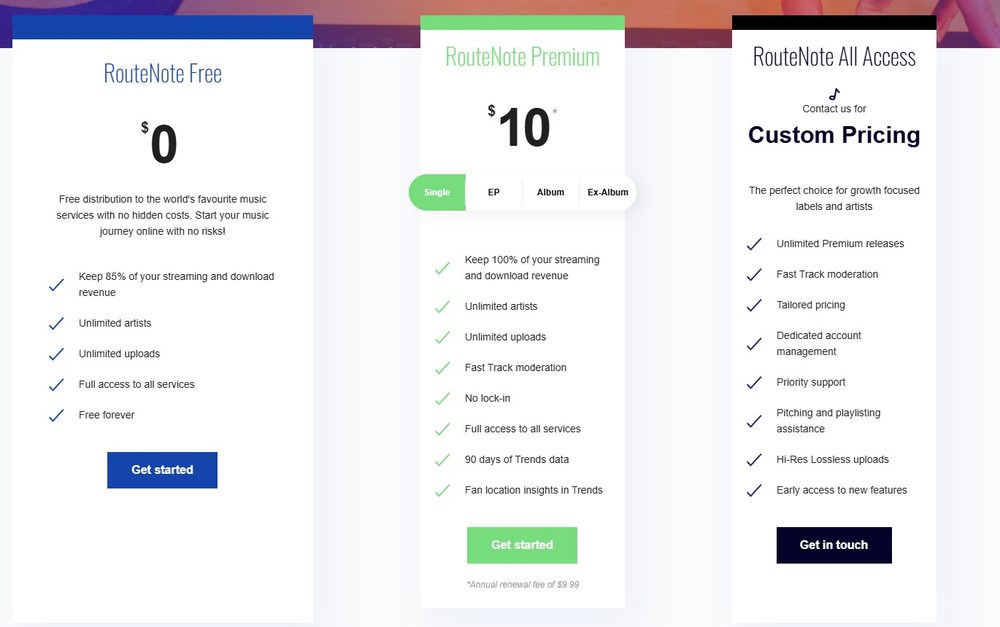
RouteNote lets you choose per release. On Free, distribution costs $0 and RouteNote keeps 15% of your streaming and download revenue — you never pay anything out of pocket, and RouteNote says it doesn’t charge to keep your music online. On Premium, you pay once per release ($10 for a single, $20 for an EP, $30 for an album, $45 for 19+ tracks) and keep 100%; after the first year a $9.99 annual fee per release keeps it on Premium. You can switch any release between Free and Premium later, and YouTube Content ID, SoundCloud monetisation and new stores are included at no extra cost on both.
The break-even point is easy to work out. DistroKid’s cheapest plan costs $24.99 a year; 15% of your earnings equals that once your music makes about $167 a year. Below that, RouteNote Free costs you less — and if you’re building a catalog for the long run, it never sends you a bill. Above it, DistroKid or RouteNote Premium on your best-earning releases puts more money in your pocket.
What Happens When You Stop Paying?
This is the biggest practical difference, and it’s often misunderstood.
DistroKid is a rental model. In its own words: “If you don’t renew your subscription to DistroKid, your music will be removed from services.” Once your releases come down, new streams — and new royalties — stop. To keep a release online after you cancel, you have to buy the Leave a Legacy extra for it: $29 per single or $49 per album, paid separately for every release. Twenty singles would cost $580 to keep live.
Two common claims go too far, though. You do not lose money you already earned: DistroKid says you can still log in and “will still receive any earnings owed to you”, and its agreement obliges it to pay what was earned while you were a member (withdrawing your balance before you cancel is still sensible). And you are not locked in: DistroKid is non-exclusive, you keep your rights, and you can download your masters, artwork and ISRC codes from its Vault and re-upload them to another distributor. Re-using the same audio, metadata and ISRCs usually lets Spotify keep your play counts, though DistroKid says it can’t guarantee it.
RouteNote has nothing to cancel on the Free plan. Your music stays online for as long as you want, with no renewal and no fee. If you stop paying a Premium renewal, the release simply moves to Free and stays live. Takedowns are free at any time, and RouteNote is non-exclusive too. For artists who want music they put out today to still be on Spotify in ten years without paying every year, that peace of mind is RouteNote’s strongest argument.
Speed: DistroKid Is Faster
DistroKid wins clearly on speed. It says releases take several days to be reviewed and sent out, after which most stores take a few days more (Spotify 2-5 days, Apple Music 1-7, Amazon and TikTok 1-2). Musician Plus and Ultimate let you set a future release date, which matters if you are planning a launch.
RouteNote’s review queue is much longer. On October 12, 2026 its support page said moderation was taking 26-27 working days — more than five weeks — because of a high volume of submissions, with releases containing AI-generated content possibly taking longer. After approval it sends music to stores within 24 hours, and full ingestion takes 7-14 days. Releases sent back for corrections lose more time, so following RouteNote’s style guide carefully pays off.
RouteNote’s paid options help: its pricing page lists Fast Track moderation on Premium and All Access releases. If a release date matters, RouteNote Premium is worth it for that release. On Free, the fix is simply planning: upload six to eight weeks before you want the song out and set your release date accordingly.
Features and Extras
DistroKid has the larger toolbox: HyperFollow pre-save pages, automatic royalty splits with recoupment, DistroLock to block others uploading your audio, a backup Vault, Spotify and Apple Music artist profile access, cover-song licensing, Dolby Atmos delivery and its Mixea mastering service. It reaches more than 150 platforms. Many of the extras cost more per release, so a busy year of releases can cost well over the headline $24.99.
RouteNote covers the essentials at no extra cost: YouTube Content ID, Facebook/Instagram and TikTok content recognition, SoundCloud monetisation, revenue splits with collaborators, PUSH.fm pre-save and smart links, Spotify for Artists claims, Trends analytics (90 days and fan locations on Premium) and an iOS app. Its store list includes Spotify, Apple Music, Amazon Music, YouTube Music, TikTok, Instagram, Deezer, Tidal, Pandora and a large network of Chinese and Korean services such as Tencent’s QQ Music. RouteNote Publishing collects songwriter royalties for 15%.
On payouts, DistroKid lets you withdraw from $6, with fees from about $1 for US bank transfers. RouteNote pays monthly once you reach $50, by PayPal or bank transfer.
DistroKid: Best for Frequent, Fast Releases
DistroKid is the largest independent distributor and the default choice for many working musicians. It is fast, polished and built for artists who release regularly: unlimited uploads for one flat fee, quick delivery, release-date control on Musician Plus and a long list of add-ons. Its Trustpilot rating is excellent at 4.5 out of 5 from about 42,000 reviews.
It is changing hands and under pressure, though. In July 2026 investment firm CVC Capital Partners agreed to buy a majority stake. In September 2026 Universal Music Group sued DistroKid in Delaware federal court, alleging it distributes AI-generated and infringing copies of UMG recordings; DistroKid strongly disputes the claims. Since then, some artists have reported releases being removed with little explanation, so keep backups of your files and codes whichever distributor you use.
Pros
- Fast: releases live within days
- Keep 100% of royalties
- Unlimited uploads for one annual fee
- Custom release dates (Musician Plus)
- Large set of tools and 150+ platforms
- $6 minimum withdrawal
Cons
- No free plan
- Music is taken down if you stop paying
- Leave a Legacy costs $29-$49 per release
- Content ID costs extra plus 20%
- Add-ons add up
RouteNote: Best Free Music Distributor
RouteNote is a UK company that has distributed music from Cornwall since 2007 and says it has more than three million users. It’s the distributor we recommend to most new and independent artists, and one we’ve used ourselves: you can put out unlimited releases for unlimited artists without paying a cent, your music stays online for good, and Content ID and SoundCloud monetisation are included. When a release starts earning well, upgrade just that one to Premium to keep 100% and get Fast Track moderation.
The trade-offs are time and support. The current review queue is over five weeks, support says it replies in around 8-10 working days, and its Trustpilot score is a mixed 3.2 out of 5, with most complaints about waiting. If you plan ahead, though, the free model is hard to beat.
Pros
- Completely free: no upfront or yearly fees
- Music stays live forever on Free
- Optional Premium per release keeps 100%
- Free YouTube Content ID and SoundCloud monetisation
- Switch releases between Free and Premium anytime
- No lock-in, free takedowns
Cons
- RouteNote keeps 15% on Free
- Review queue over 5 weeks on Free (Oct 2026)
- Slow support replies
- $50 payout minimum
Frequently Asked Questions
Is RouteNote better than DistroKid?
For most new and independent artists, yes: RouteNote is free, keeps your music online without a yearly fee and includes YouTube Content ID. DistroKid is better if you release often, need fast turnaround and earn enough that its $24.99 yearly fee costs less than RouteNote’s 15% share.
Is RouteNote really free?
Yes. RouteNote Free costs nothing to release or to keep music online; RouteNote keeps 15% of streaming and download revenue and you get 85%. Premium is optional, from $10 per release plus $9.99 a year after the first year, and lets you keep 100%.
What happens to my music if I stop paying DistroKid?
DistroKid removes your releases from streaming services unless each one has the Leave a Legacy extra ($29 per single, $49 per album). DistroKid says you still receive any earnings owed to you, and you can download your files and ISRC codes from its Vault and move to another distributor.
Do you lose your royalties if you cancel DistroKid?
Not the money already earned: DistroKid says you will still receive any earnings owed to you. But once your music is taken down it stops earning, so you lose all future royalties from those releases unless you paid for Leave a Legacy or re-upload them elsewhere.
How long does RouteNote take to release music?
In October 2026 RouteNote’s moderation queue was 26-27 working days, then up to 7-14 days for stores to ingest the release. Premium releases get Fast Track moderation. Upload at least six to eight weeks before your planned release date on the Free plan.
Can I switch from DistroKid to RouteNote?
Yes. Upload the same audio, artwork and metadata with the same ISRC codes to RouteNote, wait until the release is live, then delete it from DistroKid. Matching ISRCs and metadata usually let Spotify keep your play counts, though no distributor can guarantee it.
Final Verdict
RouteNote is the better choice for most independent artists. It costs nothing to release music or to keep it online, includes Content ID, and lets you upgrade individual releases to Premium once they earn enough to justify it. The price of free is RouteNote’s 15% and patience: plan your releases more than five weeks ahead.
DistroKid is better for prolific, career-focused artists who release often, need music live within days on a set date and earn more than about $167 a year — as long as you’re prepared to pay every year, or pay Leave a Legacy per release, to keep your catalog online.
Starting out? Sign up for RouteNote Free, release your first songs at no cost and decide later whether anything is worth paying for.