
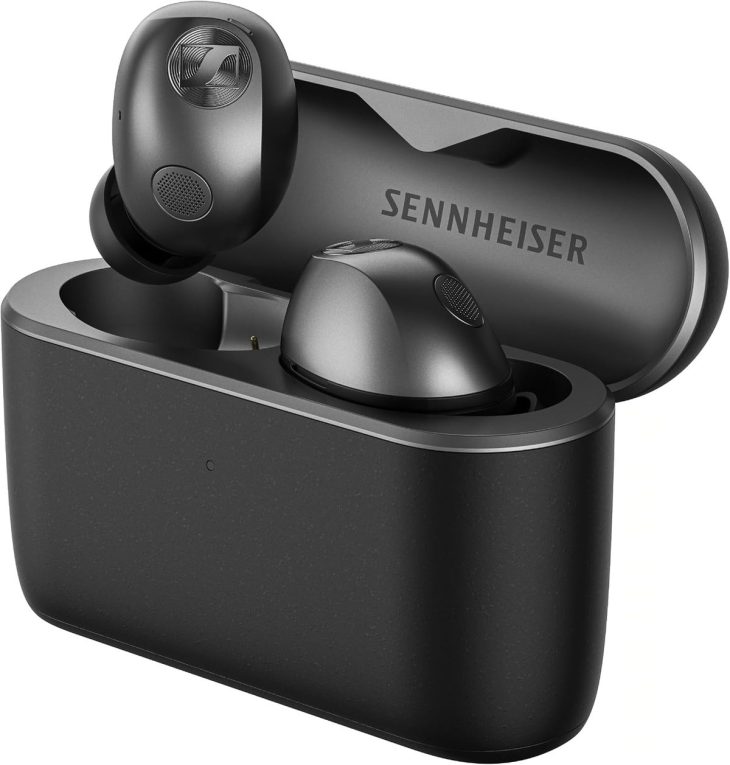
Sennheiser has spent a decade making wireless earbuds that sound better than they sell, and the Momentum True Wireless 5 — launched in August 2026 at $299.95 — is the most complete version of that formula yet. It is also, notably, one of the only flagship earbuds you can buy in 2026 with batteries you can actually replace when they wear out. Add Dolby Atmos with head tracking, Bluetooth 6.0, and aptX Lossless, and Sennheiser has built something that competes on features rather than just on sound. At $300 it is priced above the AirPods Pro and above most of the Sony and Bose competition, which raises a fair question: what exactly are you paying for?
Reviews Universe is reader-supported. When you buy through links on our site, we may earn an affiliate commission at no extra cost to you.
The Short Version
Rating: 8.7/10
Best for: Listeners who want audiophile-grade sound in a true wireless earbud and care about long-term ownership
Price: $299.95
Verdict: The best-sounding mainstream wireless earbuds of 2026, and the only flagship pair with user-replaceable batteries. Noise cancelling is good rather than class-leading, and the 6-hour battery with noise cancelling on is the one genuine weak spot.
Sennheiser Momentum True Wireless 5 Overview
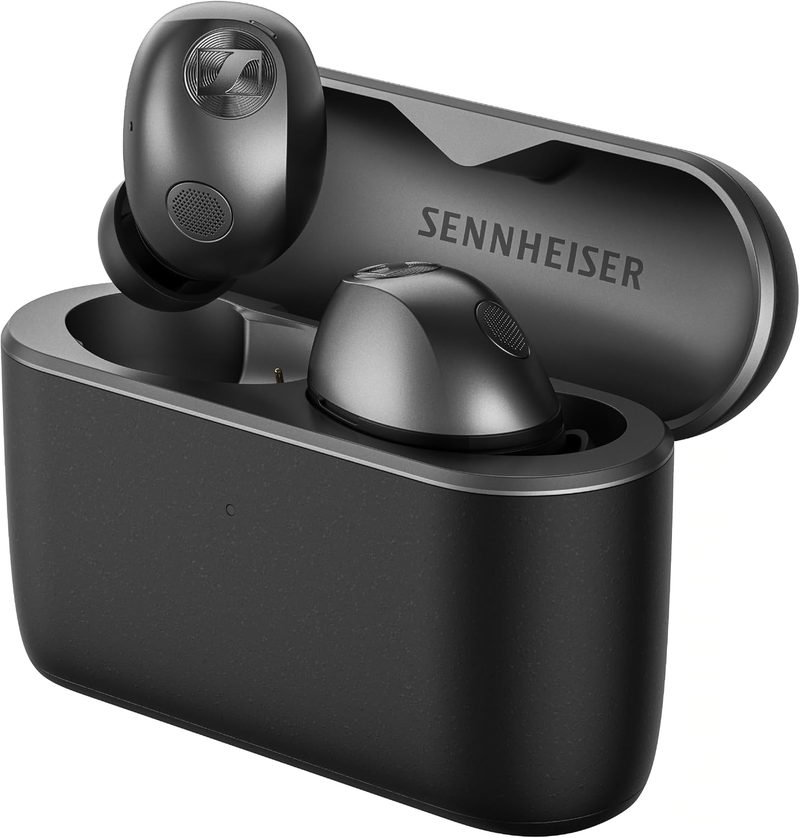
The Momentum True Wireless 5 arrived in August 2026 as Sennheiser’s flagship wireless earbuds, priced at $299.95 in five finishes: Graphite, Cream, Copper, Denim, and Lavender. The physical redesign is the first thing you notice. Sennheiser dropped the stabilizing fin that previous Momentum earbuds relied on, moving to a fin-less aerodynamic housing that sits flatter in the ear. Each earbud weighs 7 grams and the whole package — both earbuds plus case — comes in at 69 grams, which is light enough to forget in a jacket pocket.
Inside is Sennheiser’s 7mm TrueResponse dynamic transducer, the same driver family that has been quietly outperforming its price bracket for several generations. The published frequency response runs from 5 Hz to 21 kHz with total harmonic distortion under 0.08%, and sensitivity is rated at 107 dB SPL. Those are specifications you would expect from a wired audiophile in-ear monitor rather than a pair of Bluetooth earbuds, and they are the reason Sennheiser can charge $300 while Apple and Samsung sell for less.
The feature list is where this generation makes its real jump over the Momentum True Wireless 4. Bluetooth moves from 5.4 to 6.0. Dolby Atmos spatial audio with head tracking is new. The microphone system expands to four microphones per earbud plus a bone-conduction sensor for voice pickup. And the batteries — in both the earbuds and the case — are user-replaceable, which is close to unheard of in this category.
Sennheiser Momentum True Wireless 5 Specs
| Momentum True Wireless 5 | |
|---|---|
| Price | $299.95 |
| Released | August 2026 |
| Driver | 7mm TrueResponse dynamic transducer |
| Frequency response | 5 Hz – 21 kHz |
| Sensitivity | 107 dB SPL (1 kHz / 1 mW) |
| Total harmonic distortion | Under 0.08% |
| Bluetooth | 6.0 |
| Codecs | SBC, AAC, aptX, aptX Adaptive, aptX Lossless |
| Spatial audio | Dolby Atmos with head tracking |
| Noise cancelling | Hybrid adaptive with automatic anti-wind mode |
| Microphones | Four per earbud plus bone-conduction sensor |
| Battery (noise cancelling off) | Up to 12 hours |
| Battery (noise cancelling on) | Up to 6 hours |
| Total with case | Up to 40 hours |
| Quick charge | 8 minutes = 1 hour playback |
| Replaceable batteries | Yes – 72 mAh per earbud, 760 mAh case |
| Water resistance | IP54 |
| Weight | 7 g per earbud, 69 g total with case |
| Case dimensions | 67.2 x 48.4 x 25.0 mm |
| Colors | Graphite, Cream, Copper, Denim, Lavender |
Design and Build Quality
Removing the stabilizing fin was a risk and it mostly pays off. The fin-less housing sits flatter and looks considerably less medical than previous Momentum earbuds, and for most ear shapes the seal holds fine through a walk or a commute. If you have shallow ear canals or you plan to run in these, try them before committing — the trade-off for the cleaner profile is that there is nothing mechanically bracing the earbud in place beyond the ear tip itself.
The IP54 rating covers dust and splashes, which means light rain and gym sweat are fine but submersion is not. That is one step below the IPX7 ratings some sport-focused earbuds carry, and it reflects what these are: premium listening earbuds that tolerate exercise rather than earbuds designed for it.
The charging case is compact at 67.2 x 48.4 x 25.0 mm and, unusually, serviceable. Sennheiser designed both the earbud batteries (72 mAh each) and the case battery (760 mAh) to be replaced rather than thrown away. Every pair of wireless earbuds ever made eventually dies because its lithium-ion cells degrade past usefulness, typically in two to four years. This is the first flagship pair that treats that as a repair rather than a replacement purchase. If you keep your gear a long time, this single design decision may be worth the price premium on its own.
Sound Quality and Performance
Audio Fidelity
This is why you buy Sennheiser. The 7mm TrueResponse driver produces the kind of controlled, textured low end that most true wireless earbuds fake with a bass boost, and the midrange — where vocals and most instruments live — is presented honestly rather than scooped out to make the bass sound bigger. Sennheiser’s house tuning leans musical rather than clinically flat, which means it is enjoyable straight out of the case without an hour of equalizer work. The Smart Control app offers full equalizer adjustment if you want to reshape it.
The codec support matters here. Alongside SBC and AAC, the Momentum True Wireless 5 supports aptX, aptX Adaptive, and critically aptX Lossless. On a compatible Android phone — generally a recent Snapdragon flagship — aptX Lossless delivers bit-perfect audio over Bluetooth, which is as close as wireless listening currently gets to a wired connection. On an iPhone you are capped at AAC and lose that advantage entirely, so a substantial part of what you are paying for only unlocks on Android.
Noise Cancelling
The hybrid adaptive noise cancelling is good without being class-leading. Four microphones per earbud handle both the noise cancelling and an automatic anti-wind mode that kicks in when it detects turbulence across the microphone ports — genuinely useful if you walk or cycle in exposed conditions. Low-frequency drone from engines and air conditioning is handled well. Sudden mid-range noise, like nearby conversation in a cafe, gets reduced rather than removed. If absolute silence is your priority, Bose still owns that ground. If you want silence that does not audibly compress the music underneath it, Sennheiser’s approach is the more transparent one.
Call Quality
The bone-conduction sensor in each earbud reads the vibration of your own voice through your skull and uses it to separate you from background noise. Paired with the four-microphone array, this is a clear improvement over the Momentum True Wireless 4 and puts call quality in the upper tier of true wireless earbuds — usable on a busy street, not just in a quiet room.
Battery Life
Here is the one real weakness. With noise cancelling switched off you get up to 12 hours from the earbuds, which is excellent. Switch noise cancelling on — which is how most people will use them most of the time — and that drops to around 6 hours. Six hours is enough for a work day with a lunchtime top-up, or for a medium-haul flight, but it is not enough for a long-haul flight without returning them to the case. Total capacity including the case is up to 40 hours, and an 8-minute charge buys an hour of playback, which softens the problem considerably in daily use.
Pros and Cons
Pros
- Best-in-class sound from the 7mm TrueResponse driver, 5 Hz to 21 kHz
- aptX Lossless support for bit-perfect wireless audio on compatible Android phones
- User-replaceable batteries in both earbuds and case — almost unique at this price
- Dolby Atmos spatial audio with head tracking
- Bluetooth 6.0 with LE Audio and Auracast coming via firmware update
- Excellent call quality from four microphones plus a bone-conduction sensor
- Automatic anti-wind mode for outdoor listening
- Light at 7 g per earbud, and five genuinely distinct color options
Cons
- Only about 6 hours of battery with noise cancelling active
- Noise cancelling is good but does not match Bose for outright silence
- aptX Lossless does nothing on an iPhone — Apple devices cap out at AAC
- $299.95 is more than most flagship rivals
- Fin-less design may not stay secure in every ear shape during exercise
- IP54 handles sweat and light rain but not submersion
Who Should Buy the Momentum True Wireless 5
Buy these if you listen critically. If you can hear the difference between a good and a great pair of earbuds and it matters to you, this is the pair to buy in 2026. Nothing else in the mainstream true wireless market matches the driver quality, and the aptX Lossless support on Android removes the last technical excuse for wireless sounding worse than wired.
Buy these if you keep your gear. The replaceable batteries change the ownership maths. A $300 pair that lasts six years costs less per year than a $200 pair you replace every two and a half years when its cells die. If you are the kind of buyer who still has working headphones from 2019, this is aimed directly at you.
Do not buy these if noise cancelling is the whole point. If you fly constantly and want the world switched off, Bose is still the answer and the money is better spent there.
Do not buy these if you are on an iPhone and price-sensitive. A meaningful slice of the value here is aptX Lossless, which Apple devices cannot use. You would still get excellent sound over AAC, but you would be paying a premium for a headline feature you cannot access.
Alternatives to Consider
Sennheiser Momentum True Wireless 4 ($179.95) — The previous generation is still on sale and now costs $120 less. You lose Dolby Atmos, Bluetooth 6.0, the upgraded microphone array, and the replaceable batteries, but you keep the same fundamental Sennheiser sound signature. For most listeners this is the better value purchase, and it is the honest recommendation if the $300 price makes you hesitate.
Bose QuietComfort Headphones (2nd Gen) ($359) — If you want maximum noise cancelling and do not need the earbud form factor, these over-ear headphones deliver dramatically more silence and 24 hours of battery life for $59 more.
Sennheiser Momentum 5 Wireless ($399.95) — The over-ear sibling. Same audio philosophy, 56 hours of battery life, and a much bigger soundstage, if you can live with the size.
Frequently Asked Questions
How long does the Sennheiser Momentum True Wireless 5 battery last?
Up to 12 hours from the earbuds with noise cancelling switched off, dropping to around 6 hours with noise cancelling active. The charging case brings the total to up to 40 hours. An 8-minute quick charge delivers about 1 hour of playback. The 6-hour figure with noise cancelling on is the weakest number in the specification sheet — enough for a work day, not enough for a long-haul flight without a top-up.
Can you replace the batteries in the Momentum True Wireless 5?
Yes, and this is one of the headline features. Sennheiser designed both the earbud batteries (72 mAh each) and the charging case battery (760 mAh) to be user-replaceable. Because lithium-ion cells degrade over two to four years, this is the difference between repairing a $300 pair of earbuds and replacing them. Almost no other flagship wireless earbuds in 2026 offer this.
Does the Momentum True Wireless 5 support lossless audio?
Yes, through aptX Lossless, but only on compatible devices. You need an Android phone with a recent Qualcomm Snapdragon chipset that supports the aptX Lossless standard. On an iPhone, or on Android phones without the right chipset, the earbuds fall back to AAC, which is a lossy codec. They will still sound very good on an iPhone — just not lossless.
Is the Momentum True Wireless 5 good for running and the gym?
It is acceptable rather than ideal. The IP54 rating handles sweat and light rain without trouble. The concern is fit: Sennheiser removed the stabilizing fin that previous Momentum earbuds used, so the earbuds rely entirely on the ear tip seal to stay in place. Many people will have no problem, but if you have shallow ear canals or run hard, a sport-specific pair with a fin or hook is a safer purchase.
What is the difference between the Momentum True Wireless 5 and True Wireless 4?
The Momentum True Wireless 5 adds Dolby Atmos spatial audio with head tracking, upgrades Bluetooth from 5.4 to 6.0, expands to four microphones per earbud plus a bone-conduction sensor, extends battery life, improves the noise cancelling and transparency modes, and introduces user-replaceable batteries. The core 7mm TrueResponse driver and Sennheiser’s sound signature carry over, which is why the older model at $179.95 remains a strong value option.
Is the Sennheiser Momentum True Wireless 5 worth $300?
It is worth it if you value sound quality above all else, or if you plan to own the earbuds for many years and the replaceable batteries appeal to you. It is not worth it if noise cancelling is your main priority, since Bose does that better, or if you use an iPhone and are buying primarily for the aptX Lossless support that Apple devices cannot access. The Momentum True Wireless 4 at $179.95 is the value alternative within the same family.
Final Verdict
The Sennheiser Momentum True Wireless 5 is the best-sounding pair of mainstream wireless earbuds you can buy in 2026, and it earns its $299.95 price on audio quality and longevity rather than on feature-count marketing. The 7mm TrueResponse driver, aptX Lossless support, and honest tuning put it ahead of everything Apple, Samsung, and Bose currently sell on pure fidelity. The user-replaceable batteries are the sleeper feature — the first serious attempt by a major brand to make flagship earbuds outlast their own cells.
The compromises are real and worth stating plainly. Six hours of battery with noise cancelling active is below par for the price. The noise cancelling itself is good but not the class leader. And if you are on an iPhone, you are paying for an aptX Lossless capability you cannot use.
Rated 8.7 out of 10. If you listen closely and keep your equipment for years, buy these. If you mainly want quiet, buy Bose. And if $300 is a stretch, the Momentum True Wireless 4 at $179.95 delivers most of the sound for a lot less money.