
Bosch has just brought its fully automatic bean-to-cup machines to American kitchens, and the timing is awkward for KitchenAid. The Bosch Series 6 arrives at $1,299 with a touchscreen, 25 drinks on the machine and 41 through its app, and full smart-home integration. The KitchenAid KF3 counters at $999.95 with a deliberately compact body, a genuinely clever iced coffee system, and $300 left in your pocket. Both are bean-to-cup machines that grind, brew, and froth at a single button press. Choosing between them comes down to whether you want the machine that does the most, or the machine that fits your kitchen and your actual drinking habits.
Reviews Universe is reader-supported. When you buy through links on our site, we may earn an affiliate commission at no extra cost to you.
Quick Verdict
Winner for most kitchens: the KitchenAid KF3 at $999.95. It is $300 cheaper, roughly a quarter smaller on the counter, and its low-temperature iced coffee brewing is the more useful feature for the way most people actually drink coffee now.
Buy the KitchenAid KF3 if counter space matters, you drink iced coffee regularly, or you want the best espresso per dollar.
Buy the Bosch Series 6 if you have a household with different tastes to satisfy, want a touchscreen and saved profiles, or care about controlling the machine from your phone and by voice.
Bosch Series 6 vs KitchenAid KF3: Specs Compared
| Bosch Series 6 | KitchenAid KF3 (KES8453) | |
|---|---|---|
| Price | $1,299 | $999.95 |
| Drinks on the machine | 25 | 15+ hot and over-ice |
| Drinks via app | Up to 41 | Not applicable |
| Display | 3.7 inch touchscreen | Control panel |
| Grinder | Ceramic burr | Built-in burr with Intelligrind |
| Automatic dose adjustment | Yes | Yes – detects and fine-tunes per bean |
| Milk system | Direct from any container | AutoMilk with dual delivery from main spout |
| Plant-based milk | Yes | Yes |
| Iced coffee | Cold Brew setting | Dedicated over-ice low-temperature brewing |
| Two cups at once | Yes, including milk drinks | Not specified |
| Extra large drinks | Up to 16.2 oz | Not specified |
| Travel mug clearance | Adjustable tray, up to 6.5 in | Not specified |
| Saved profiles | Up to 10 | Not specified |
| Smartphone app | Home Connect | No |
| Voice control | Yes, via Home Connect | No |
| Quiet grinding | Not specified | Yes – Quiet Grinding System |
| Footprint | Full size | 25% smaller than KitchenAid KF6/KF7/KF8 |
| Self-cleaning | Automatic steam clean after milk drinks | Automatic rinse at switch-on |
| Water tank | Not specified | 1.8 litres |
Bosch Series 6 — The Feature Flagship ($1,299)
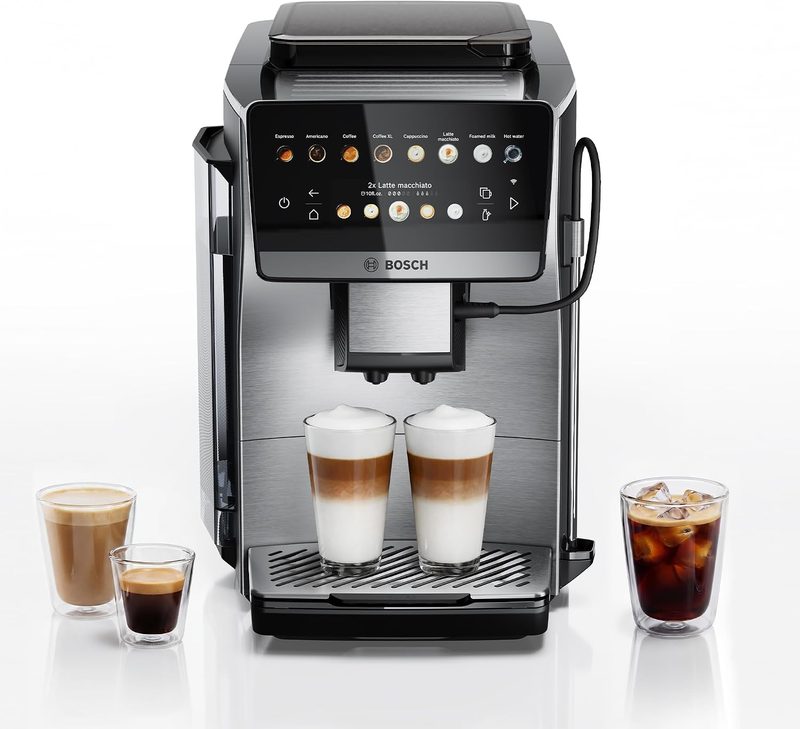
The Series 6 is Bosch making a statement about what a bean-to-cup machine should offer in 2026. The headline number is drink variety: 25 recipes available directly on the machine, extending to 41 through the Home Connect app, spanning straight espresso, the full range of milk drinks, and Cold Brew. If your household has four people who each want something different, this is the machine that stops the arguments.
Control runs through a 3.7-inch touchscreen where you adjust strength, aroma, cup size, and milk ratio, then save up to 10 favorites. Those saved profiles are the feature that makes a shared machine actually pleasant to live with — each person presses their own name rather than re-dialing settings every morning. Quick Cup is a nice piece of practical design: hold your drink selection and the machine skips its pre-rinse cycle to start brewing in seconds, which matters on the mornings you are already late.
Capacity is well thought out. It brews two cups simultaneously, including milk drinks, which most machines at this price cannot do. Extra-large drinks run to 16.2 ounces, and the drip tray adjusts to fit travel mugs up to 6.5 inches tall — a small detail that anyone who commutes with coffee will appreciate. Milk comes directly from whatever container you have, carton, jug, or bottle, and works with dairy or plant-based alternatives without a special reservoir.
Grinding is handled by a ceramic burr grinder, brewing with regulated flow and heat. The Home Connect app adds remote start from your phone, voice activation, and access to international drink recipes. Cleaning is largely automatic, with a steam clean after every milk-based drink.
Pros
- 25 drinks on the machine and up to 41 through the app
- 3.7 inch touchscreen with up to 10 saved profiles
- Brews two cups at once, including milk drinks
- Extra large drinks up to 16.2 oz and travel mugs up to 6.5 in
- Quick Cup skips the pre-rinse to brew in seconds
- Ceramic burr grinder
- Home Connect app with remote start and voice activation
- Automatic steam cleaning after every milk drink
Cons
- $300 more than the KitchenAid KF3
- Full-size footprint on the counter
- Cold Brew is a setting rather than a dedicated low-temperature system
- Smart features depend on the Home Connect app and your network
- New to the American market, so long-term service history is unproven
KitchenAid KF3 — The Compact Specialist ($999.95)
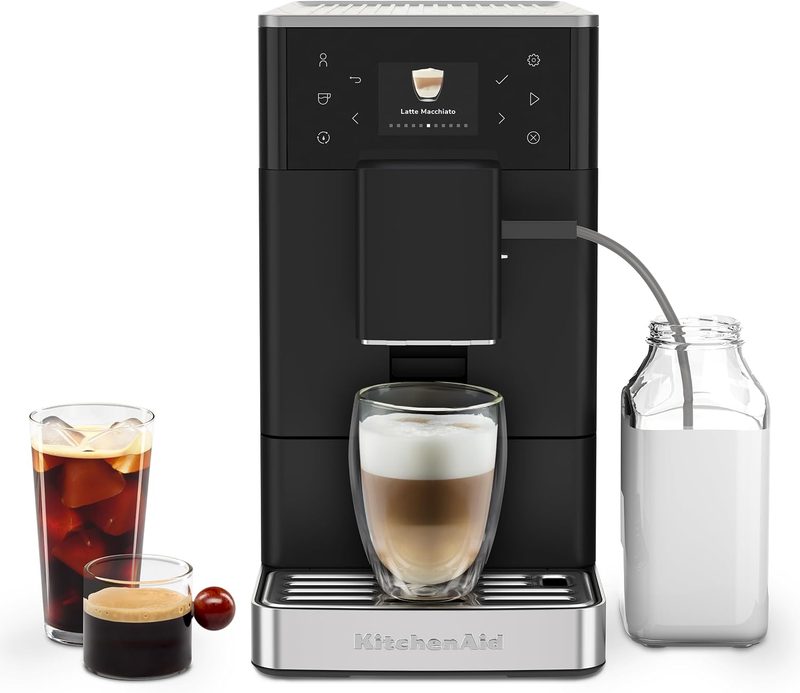
KitchenAid took the opposite approach with the KF3. Rather than adding features, it removed volume: the KF3 is 25% smaller than the company’s own KF6, KF7, and KF8 machines while keeping the performance. Anyone who has tried to fit a bean-to-cup machine under a wall cabinet will understand why this matters more than another ten drink recipes. It is the rare premium appliance designed around the constraint most kitchens actually have.
The genuinely clever engineering is the iced coffee system, and it is more than a marketing setting. The KF3 has dedicated over-ice coffee and espresso modes that brew at a deliberately lower temperature. The reason is chemistry: when hot espresso hits ice, it over-extracts and then dilutes, which is why most iced coffee made on a standard machine tastes simultaneously bitter and weak. Brewing cooler protects the flavor so the drink stays smooth and balanced as it cools. Given how much of American coffee consumption is now iced, this is the most practically useful difference between these two machines.
The built-in burr grinder runs KitchenAid’s Intelligrind system, which detects the bean type and roast and fine-tunes the dose automatically — no manual adjustment when you switch from a dark Italian roast to a light single origin. The Quiet Grinding System addresses the loudest thing any bean-to-cup machine does, which is worth something at six in the morning in a house with people asleep.
The AutoMilk system adjusts milk texture and volume per drink with dual delivery through the main spout, using your own milk container. Note that the dedicated milk container is sold separately — a mild irritation at this price. The machine rinses itself on switch-on to warm the pipes and brew unit. In the box you get a 1.8-litre water tank, a water filter, two cleaning tablets, a coffee spoon, and a milk hose.
Pros
- $300 cheaper than the Bosch Series 6
- 25% smaller than KitchenAid’s own KF6, KF7 and KF8 machines
- Dedicated low-temperature brewing for genuinely good iced coffee
- Intelligrind detects bean type and adjusts the dose automatically
- Quiet Grinding System for early mornings
- AutoMilk adjusts texture and volume per drink
- 15+ hot and over-ice recipes at a button press
- Automatic rinse at switch-on
Cons
- Fewer drink options than the Bosch Series 6’s 25 to 41
- No smartphone app, remote start, or voice control
- The dedicated milk container is sold separately
- No touchscreen or saved user profiles
- Does not brew two cups at once
Head-to-Head: Where the $300 Goes
Drink Variety: Bosch, Comfortably
25 drinks on the machine against 15-plus, extending to 41 through the app, is not a close contest. If your household contains a flat white drinker, a double espresso drinker, and someone who wants a large oat milk latte in a travel mug, the Bosch handles all of it with each person’s preferences saved to a profile. The KitchenAid covers the mainstream drinks well but does not pretend to the same breadth.
Iced Coffee: KitchenAid, Decisively
Both machines make cold drinks; only one was engineered for it. The Bosch offers a Cold Brew setting. The KitchenAid has separate over-ice coffee and espresso modes that actually lower the brewing temperature to prevent the over-extraction that makes most machine-made iced coffee taste harsh. If you drink iced coffee more than occasionally, this single difference outweighs the Bosch’s larger menu.
Counter Space: KitchenAid, By Design
This is the most underrated specification when buying a bean-to-cup machine. These are large appliances, and a 25% reduction in size is the difference between fitting under a wall cabinet and not. Measure your available height and depth before you decide anything else — there is no point owning the machine with more drinks if it has to live in a cupboard.
Smart Features: Bosch, If You Want Them
Home Connect gives the Bosch remote start from your phone, voice activation, and additional international recipes downloaded to the machine. Whether that is worth money is a genuine question. Starting a coffee from bed is a real convenience if your machine is on a schedule that suits it; it is also a feature that depends on an app and a network connection continuing to be supported years from now. The KitchenAid has no app at all, which is either a limitation or a virtue depending on your view.
Grinding: A Split Decision
Bosch uses a ceramic burr grinder, which stays sharp longer than steel and does not transfer heat into the grounds. KitchenAid’s Intelligrind is the smarter system, detecting the bean and adjusting the dose automatically so you get consistency across different roasts without touching a setting. Bosch wins on component quality, KitchenAid on automation. In the cup, both produce a properly ground, consistent dose.
Value: KitchenAid
$999.95 against $1,299 is a 23% price difference for machines that both grind fresh beans, froth milk automatically, and clean themselves. The Bosch justifies the gap with menu breadth, the touchscreen, saved profiles, dual-cup brewing, and the app. Those are real features, and for a busy household with varied tastes they add up. For one or two people who mostly drink the same two or three drinks, they do not — and the KitchenAid’s smaller body and better iced coffee are worth more day to day.
Frequently Asked Questions
Is the Bosch Series 6 or KitchenAid KF3 better?
For most kitchens the KitchenAid KF3 is the better buy at $999.95 — it costs $300 less, takes up 25% less counter space than KitchenAid’s larger models, and brews genuinely good iced coffee thanks to dedicated low-temperature modes. The Bosch Series 6 at $1,299 is the better machine for households with varied tastes, offering 25 drinks on the machine and up to 41 via its app, a 3.7 inch touchscreen, up to 10 saved profiles, and smartphone and voice control.
What is a fully automatic bean-to-cup espresso machine?
A bean-to-cup machine grinds whole beans, doses and tamps the grounds, brews the espresso, and froths the milk automatically at a single button press. You add beans, water, and milk, and the machine does everything else including rinsing itself afterwards. This is different from a semi-automatic espresso machine, where you grind, tamp, and steam milk yourself. Both machines in this comparison are fully automatic.
Why does the KitchenAid KF3 brew iced coffee at a lower temperature?
Because pouring hot espresso over ice ruins it. Coffee brewed at full temperature and then chilled over-extracts, producing bitterness, and then dilutes as the ice melts, producing weakness — which is why iced coffee made on a standard machine often tastes both harsh and watery. The KF3’s dedicated over-ice modes brew cooler to prevent that over-extraction, so the drink stays smooth and balanced as it cools.
Can these espresso machines use oat milk and other plant-based milks?
Yes, both handle plant-based milk. The Bosch Series 6 draws milk directly from whatever container you have — carton, jug or bottle — and works with dairy or plant-based alternatives. The KitchenAid KF3’s AutoMilk system adjusts texture and volume per drink using your own milk container, though note that KitchenAid’s dedicated milk container is sold separately. Oat milk generally froths best of the plant-based options.
How much counter space do you need for a bean-to-cup machine?
More than people expect, which is why the KitchenAid KF3’s 25% size reduction over KitchenAid’s KF6, KF7 and KF8 models is one of its strongest selling points. Measure both the depth of your counter and the height clearance under any wall cabinets before buying, and remember you need room above the machine to refill the bean hopper and water tank. This is the specification most likely to cause regret if you ignore it.
Is a $1,000 espresso machine worth it over a cheaper one?
The value case depends on volume. If two people each buy a $5 coffee on the way to work, that is roughly $2,600 a year, so a $1,000 machine pays for itself within months and then keeps producing. What the money buys over a cheaper machine is a proper burr grinder, automatic milk frothing that actually textures rather than just heating, self-cleaning cycles that keep the machine hygienic, and build quality intended to last years rather than seasons.
Final Verdict: Which Espresso Machine Should You Buy?
Buy the KitchenAid KF3 at $999.95. For the majority of buyers this is the smarter purchase. It saves $300, it is designed to actually fit on a real kitchen counter, its Intelligrind system handles bean changes without you touching a setting, and its low-temperature iced coffee brewing addresses how a great many people genuinely drink coffee rather than how machine manufacturers assume they do.
Buy the Bosch Series 6 at $1,299 if you are equipping a busy household. 25 drinks on the machine, 41 through the app, 10 saved profiles, simultaneous two-cup brewing, and travel mug clearance make it the better machine when several people with different tastes are using it every morning. The Home Connect app and voice control are genuine conveniences if you will use them.
If you like the Bosch approach but not the price, the Bosch Series 4 at $999 matches the KitchenAid on price and keeps the ceramic grinder, Home Connect app, Quick Cup, Cold Brew and automatic cleaning, dropping to 6 drinks on the machine and 20 via the app with an illuminated control panel instead of the touchscreen. For a household that wants smart features more than menu breadth, it is arguably the best value of the three.