
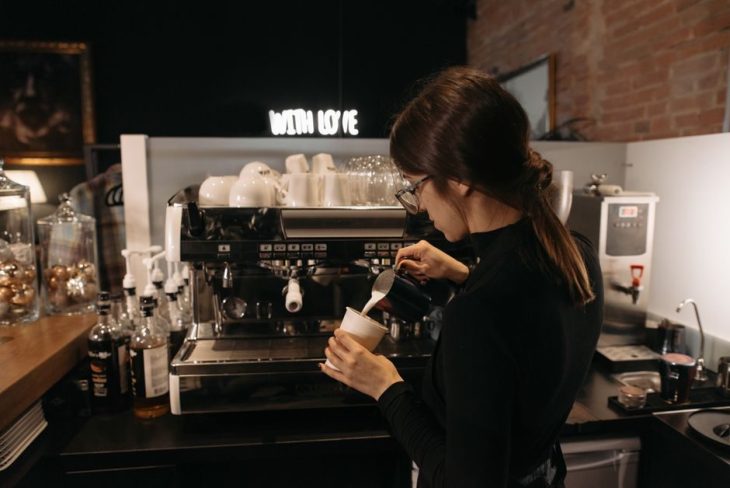
Breville’s Barista series has been the default recommendation for home espresso for over a decade, and the two machines people actually choose between are the Barista Express at $689.99 and the Barista Touch at $987.99. They share the same fundamentals — integrated conical burr grinder, low-pressure pre-infusion, digital temperature control — so the $298 between them buys exactly two things: a touchscreen, and a steam wand that textures milk for you instead of making you learn how. Whether that is worth $298 is genuinely one of the more interesting questions in home coffee, because the thing the cheaper machine forces you to learn is also the thing that makes espresso rewarding.
Reviews Universe is reader-supported. When you buy through links on our site, we may earn an affiliate commission at no extra cost to you.
Quick Verdict
Winner for most people: the Breville Barista Express at $689.99. It pulls the same quality shot as its more expensive sibling and saves you $298, and learning to steam milk by hand takes about two weeks.
Buy the Barista Express if you want to learn espresso properly, enjoy the craft, or simply want the best shot per dollar.
Buy the Barista Touch if you want consistent milk drinks without a learning curve, several people in the house will use it, or you want a machine ready to pull in three seconds rather than waiting for it to heat.
Barista Express vs Barista Touch: Specs Compared
| Barista Express (BES870XL) | Barista Touch (BES880BSS) | |
|---|---|---|
| Price | $689.99 | $987.99 |
| Type | Semi-automatic | Semi-automatic with automation |
| Milk texturing | Manual steam wand | Automatic – sets temperature and texture |
| Interface | Dials and buttons | Touchscreen |
| Heating system | Standard heating | ThermoJet – extraction temperature in 3 seconds |
| Grinder | Integrated precision conical burr | Integrated precision conical burr |
| Dose control | Grind size dial, grinds into portafilter | Single touch precise dose |
| Pre-infusion | Low pressure pre-infusion | Low pressure pre-infusion |
| Temperature control | Digital PID regulation | Digital PID regulation |
| Saved drink profiles | No | Up to 8 personalized coffees |
| Latte art capability | Yes, with practice | Yes, automatic microfoam |
| Adjustable milk settings | Fully manual | Texture and temperature adjustable |
| Bean to espresso time | Under a minute | Under a minute |
| Free coffee on registration | 2 bags | 2 bags |
Breville Barista Express — The One That Teaches You ($689.99)
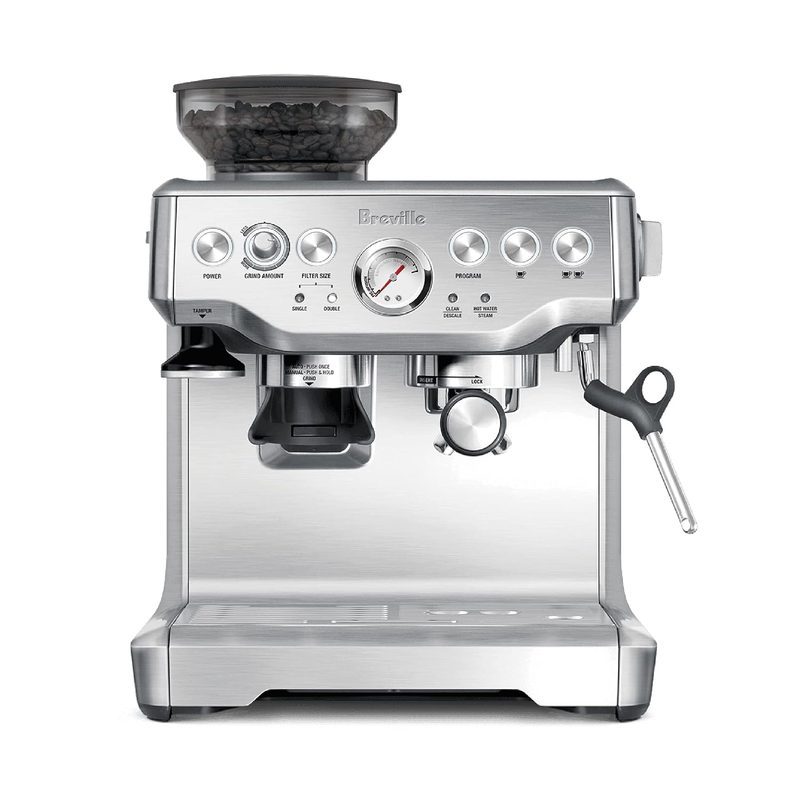
The Barista Express has probably introduced more people to real espresso than any other machine, and it does it by handling the hard engineering while leaving you the interesting decisions. The integrated precision conical burr grinder sits directly above the portafilter with a grinding cradle, so freshly ground coffee falls straight into the basket. This matters more than it sounds: ground coffee begins losing aromatic compounds within minutes, and grinding directly into the portafilter means the interval between grinding and brewing is measured in seconds.
The grind size dial is the machine’s most important control and the reason this is the machine to learn on. Grind size determines how fast water flows through the coffee bed, which determines extraction, which determines whether your espresso tastes sour, balanced, or bitter. Adjust the dial, pull a shot, taste, adjust again — this loop is what actually teaches you espresso, and the Barista Express hands you the dial and lets you do it with any roast of bean.
Two pieces of engineering do the parts you should not have to think about. Low-pressure pre-infusion gradually ramps pressure at the start of the shot rather than hitting the coffee bed at full force, which wets the grounds evenly and prevents water from channelling through weak spots. Digital temperature regulation, or PID, holds the water at precisely the right temperature — brewing even a few degrees off produces a noticeably worse shot, and this is where cheap machines fail hardest.
Milk is entirely on you. The steam wand is powerful and perfectly capable of producing the smooth microfoam that latte art requires, but you control the pitcher angle, the depth of the wand, when to stop stretching and start folding, and when the milk is at temperature. This is a real skill and it takes most people a week or two of daily practice. After that, it is faster than any automatic system and gives you complete control over texture.
Pros
- $298 cheaper than the Barista Touch for the same shot quality
- Grind size dial teaches you how extraction actually works
- Conical burr grinder grinds directly into the portafilter for maximum freshness
- Low pressure pre-infusion prevents channelling
- Digital PID temperature regulation for consistent extraction
- Manual steam wand gives complete control over milk texture once learned
- Works with any roast of bean
- Two free bags of specialty coffee on registration
Cons
- Steaming milk is a genuine skill with a one to two week learning curve
- No saved drink profiles
- Slower to heat up than the ThermoJet system in the Touch
- Results vary between users — not ideal for a shared household
- Requires more attention per drink than an automatic machine
Breville Barista Touch — The One That Does It For You ($987.99)
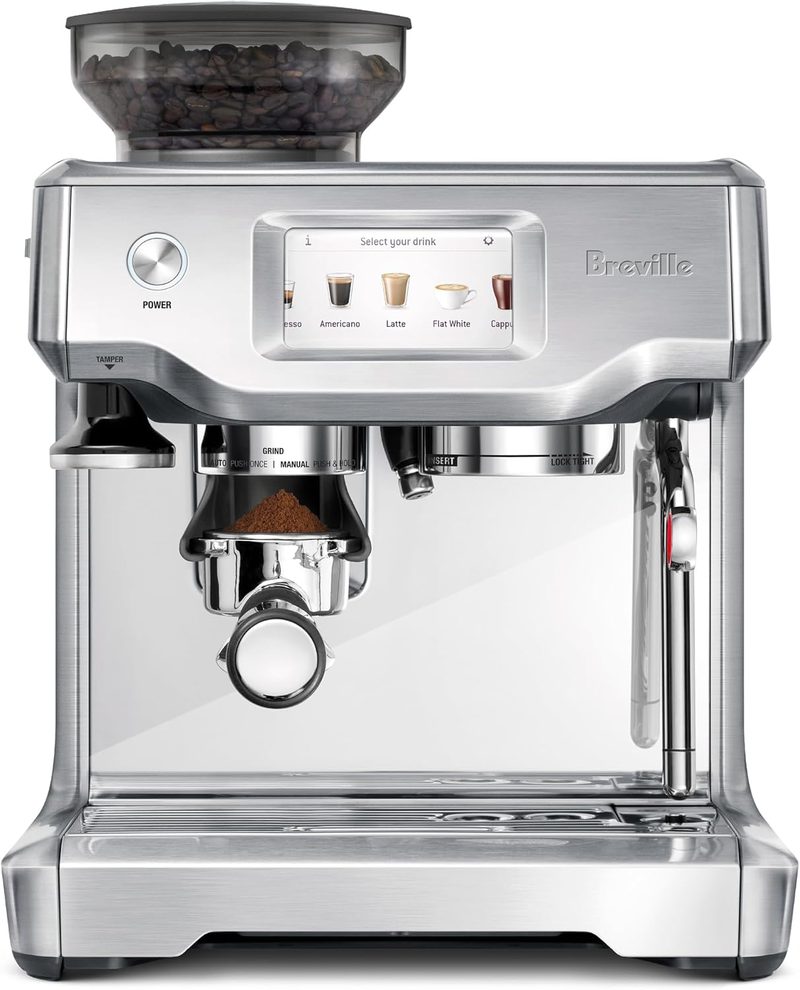
The Barista Touch takes the same core machine and removes the two things people most often get wrong. The first is milk. Its automatic steam wand lets you set milk temperature and texture directly, then produces barista-quality microfoam without you touching the pitcher. That is the entire skill gap of home espresso, automated — and it means the tenth cappuccino tastes exactly like the first, and like the one your partner makes.
The second is the interface. The touchscreen reduces the process to three steps — Grind, Brew, Milk — with coffee strength, milk texture and milk temperature adjustable at each stage. You can then save up to 8 personalized coffees, so each person in the household presses their own drink. For a machine that several people use daily, saved profiles change the experience from a negotiation into a button press.
The third difference is less advertised and arguably the most useful day to day: the ThermoJet heating system reaches extraction temperature in 3 seconds. Traditional espresso machines take several minutes to come up to temperature and hold it, which is why serious home users leave them switched on. Three seconds means you walk into the kitchen and pull a shot, which genuinely changes how often you use the machine on a weekday morning.
Everything underneath is shared with the Barista Express: the integrated precision conical burr grinder delivering a precise dose at a single touch, low-pressure pre-infusion, and digital PID temperature regulation. The shot the Touch pulls is not better than the Express’s — it is the same machine underneath. What you are buying is repeatability and speed.
Pros
- Automatic milk texturing removes the hardest skill in home espresso
- Adjustable milk temperature and texture with consistent results every time
- Touchscreen reduces the process to Grind, Brew and Milk
- Saves up to 8 personalized drinks for different people
- ThermoJet reaches extraction temperature in 3 seconds
- Same conical burr grinder, pre-infusion and PID control as the Express
- Ideal for households where several people make coffee
- Consistent results regardless of who is using it
Cons
- $987.99 — $298 more than the Barista Express
- Automating milk means you never learn to texture it yourself
- The shot quality is not better than the cheaper machine
- Touchscreen is another component that can eventually fail
- Less control over milk texture than a skilled hand with a manual wand
Head-to-Head: What $298 Actually Buys
Espresso Quality: A Genuine Tie
This is the most important thing to understand and it settles most of the decision. Both machines use the same integrated precision conical burr grinder, the same low-pressure pre-infusion, and the same digital PID temperature regulation. The espresso coming out of the Barista Express is not worse than the espresso from the Barista Touch. If you drink your coffee black, the $298 buys you a faster heat-up and a touchscreen, and nothing at all in the cup.
Milk Drinks: Touch, But With a Caveat
If you drink lattes and cappuccinos, this is where the money goes. The Touch’s automatic wand produces consistent microfoam from day one; the Express requires you to learn. The caveat is that the learning curve is genuinely short — most people are producing decent microfoam within two weeks of daily practice, and good microfoam within a month. After that, a skilled hand on a manual wand has more control than any automatic system. You are essentially paying $298 to skip two weeks and guarantee consistency forever.
Shared Households: Touch, Clearly
Manual milk steaming is a personal skill, which means in a house of four people you get four different qualities of cappuccino, and three of them are disappointed. The Touch’s automatic texturing and 8 saved profiles mean everyone gets the same result and their own settings. If more than one person makes coffee daily, this is the strongest argument for spending the extra money.
Speed: Touch
ThermoJet reaching extraction temperature in 3 seconds versus a conventional warm-up is a real quality-of-life difference on a weekday morning. It removes the friction that stops people using an espresso machine when they are in a hurry, which over months means you actually use the machine you paid for.
Learning and Enjoyment: Express
This is subjective but worth stating plainly. A large part of why people enjoy home espresso is the craft — dialling in a new bag of beans, adjusting the grind, learning to pour a rosetta. The Barista Express hands you those controls; the Barista Touch quietly handles them. If the process appeals to you, the cheaper machine is not a compromise, it is the better product.
Value: Express
Same shot, $298 less, and the skill you acquire transfers to every espresso machine you will ever use. Unless automatic milk texturing, saved profiles, or 3-second heat-up solve a specific problem you actually have, the Barista Express is the better purchase.
Frequently Asked Questions
Is the Breville Barista Touch worth $298 more than the Barista Express?
Only for specific reasons. Both machines share the same conical burr grinder, low-pressure pre-infusion and PID temperature control, so the espresso itself is equally good. The $298 buys automatic milk texturing, a touchscreen with up to 8 saved drink profiles, and ThermoJet heating that reaches extraction temperature in 3 seconds. If you drink your coffee black, it buys you almost nothing. If several people make milk drinks daily, it is worth it.
Is the Breville Barista Express hard to learn?
The espresso itself is not — the machine handles grinding, pre-infusion and temperature automatically, and you adjust one grind size dial based on taste. Steaming milk is the genuine skill, and most people produce acceptable microfoam within one to two weeks of daily practice and good microfoam within a month. If you would rather skip that entirely, the Barista Touch textures milk automatically.
What is the difference between a semi-automatic and a fully automatic espresso machine?
A semi-automatic machine like the Barista Express grinds and brews but leaves you to steam milk and control the shot. A fully automatic bean-to-cup machine does everything at one button press, including milk, with no portafilter involved. The Barista Touch sits between the two — it uses a portafilter like a semi-automatic but automates the milk texturing. Semi-automatics give more control and generally better espresso for the money; fully automatics give convenience.
Why does grind size matter so much on an espresso machine?
Grind size controls how fast water flows through the coffee. Too coarse and the water rushes through, under-extracting and producing a sour, thin shot. Too fine and the water struggles through, over-extracting and producing bitterness. Everything else on a good machine — pre-infusion, temperature stability — is designed to be consistent so that grind size is the variable you adjust by taste. The Barista Express’s grind size dial is the main control that teaches this.
Do I need a separate grinder with these machines?
No. Both the Barista Express and Barista Touch have an integrated precision conical burr grinder, which is a large part of their value — a comparable standalone burr grinder typically costs several hundred dollars on top of a machine. The Barista Express grinds directly into the portafilter through a grinding cradle, minimizing the time between grinding and brewing, which matters because ground coffee starts losing aroma within minutes.
How long do Breville espresso machines last?
With regular descaling and cleaning, many owners report a decade or more of daily use. The most common failure points are scale buildup in the boiler on machines that are never descaled, and eventually the grinder burrs, which are a wearing component. Descaling on schedule is the single most important thing you can do, and it is the maintenance task most owners skip.
Final Verdict: Which Breville Should You Buy?
Buy the Breville Barista Express at $689.99. It pulls exactly the same espresso as the machine costing $298 more, because underneath they are the same machine. The grind size dial teaches you what actually makes espresso good, the manual steam wand takes about two weeks to learn and then gives you more control than any automatic system, and you keep $298. For a single person or a couple who enjoy the process, this is the better product, not the compromise.
Buy the Breville Barista Touch at $987.99 if consistency matters more than craft. Automatic milk texturing means every cappuccino is identical regardless of who made it, 8 saved profiles keep a household of different tastes happy, and ThermoJet heating in 3 seconds removes the excuse not to use it on a rushed morning. In a busy house where several people make milk drinks daily, it earns the difference.
The question to ask yourself is simple: do you want to learn to steam milk, or do you want to never think about it? That is what $298 buys.