
These are the two chairs that end the office chair argument. The Herman Miller Aeron and the Steelcase Leap have between them dominated every serious ergonomic ranking for two decades, they both come with twelve-year warranties, and they are both still in production essentially unchanged because there has been nothing meaningful to fix. If you are spending real money on a chair once and keeping it for fifteen years, these are the two names that come up. They are also fundamentally different objects: one is a suspended mesh frame sized to your body, the other is an upholstered chair that adjusts to fit almost anyone. Which is right for you depends far more on how you sit than on which brand you have heard of.
Reviews Universe is reader-supported. When you buy through links on our site, we may earn an affiliate commission at no extra cost to you.
Quick Verdict
Winner for most people: the Herman Miller Aeron at $640. It costs less than half the new Leap, the mesh suspension stays cool through a full working day, and the sized approach means a correctly chosen Aeron fits better out of the box than any amount of adjustment.
Buy the Aeron if you run hot, want minimal fiddling once it is set, or you sit relatively upright and want firm, breathable support.
Buy the Steelcase Leap if you shift position constantly through the day, want cushioned rather than suspended support, need seat depth adjustment, or fall outside the range an Aeron size covers well.
Aeron vs Leap: Specs Compared
| Herman Miller Aeron (Size B) | Steelcase Leap | |
|---|---|---|
| Price | $640 | $1,399 new |
| Seat and back material | Pellicle woven suspension mesh | Upholstered foam |
| Sizing approach | Three sizes – A, B and C | One size, heavily adjustable |
| Size B fits | 5’5″ to 6’2″, 150-230 lbs | Not size-dependent |
| Points of adjustment | Arms, lumbar, tilt limiter, seat angle | Seven points of adjustability |
| Back technology | PostureFit supports base of the spine | 3D LiveBack contours to your spine |
| Recline system | Kinematic tilt aligned to hips, knees, ankles | Natural Glide System keeps you at the desk |
| Lumbar adjustment | Adjustable lumbar | Lumbar height plus lower back firmness dial |
| Armrests | Fully adjustable | 4D adjustable pivot arms |
| Seat depth adjustment | No | Yes |
| Breathability | Excellent – open mesh | Moderate – upholstered |
| Frame | Graphite base and frame | Black frame, Onyx upholstery |
| Recyclability | Largely recyclable at end of life | Not specified |
Herman Miller Aeron — The Suspended Mesh Classic ($640)
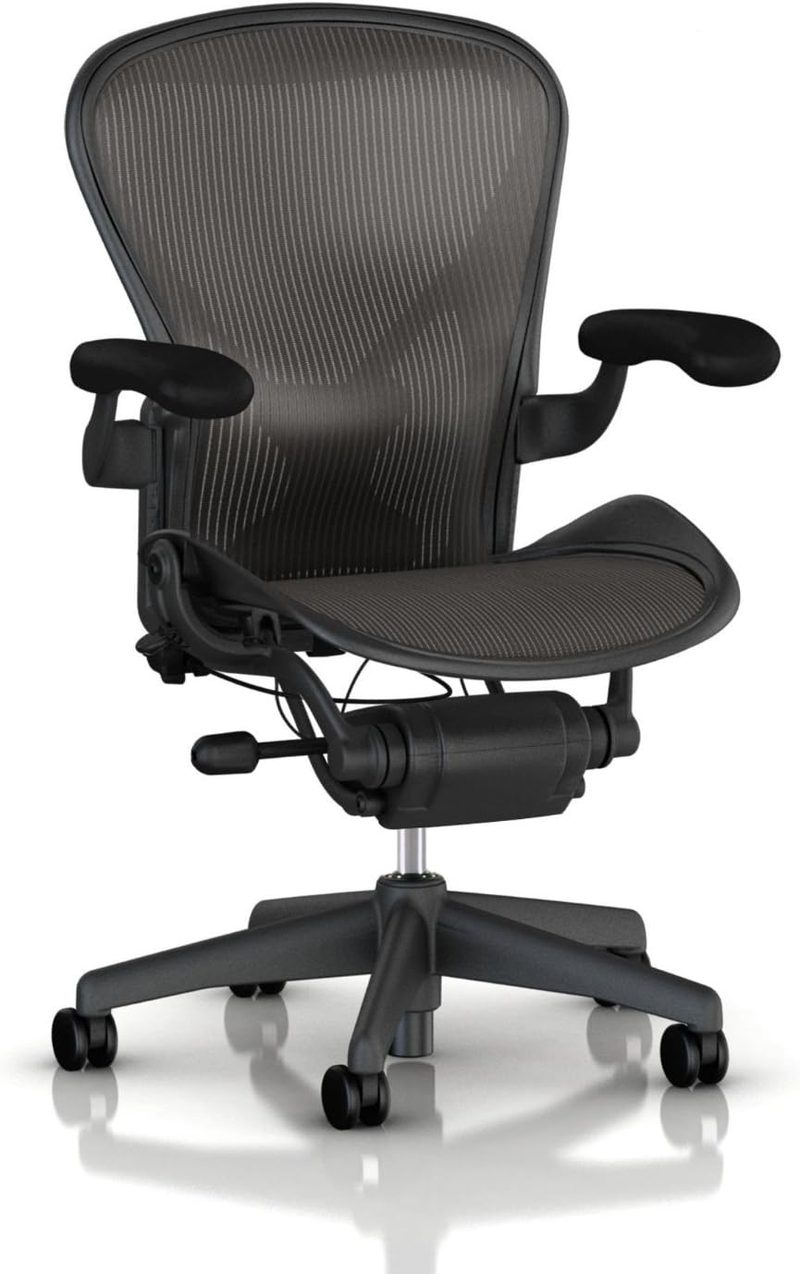
The Aeron is the most recognizable office chair ever made, and the reason it still sells decades after its introduction is the Pellicle suspension. Rather than sitting on foam, you sit on a woven textile that combines two materials with different elastic properties, tensioned across a frame. The practical effects are two. First, it distributes your weight rather than compressing under it, so there is no gradual sag over years the way foam sags. Second, air passes straight through, which means you do not finish an eight-hour day with a damp back. If you run warm, or you work somewhere without great air conditioning, this alone can settle the decision.
The Aeron is sold in three sizes rather than one adjustable size. Size B, the version here, is the middle and by far the most common, supporting people roughly 5 feet 5 inches to 6 feet 2 inches and 150 to 230 pounds. This is Herman Miller’s core design philosophy and it is worth understanding: rather than one chair with enough adjustment range to fit everyone badly, it builds three frames that fit their intended range properly. The catch is obvious — get the size wrong and no adjustment will rescue it.
PostureFit is the second signature feature, and it targets a part of the body most chairs ignore. Rather than pushing into your lumbar curve, it supports the sacral region at the very base of the spine, which is what actually holds the pelvis in the position that keeps the rest of your spine stacked properly. Most people find it strange for a week and then cannot sit without it.
The kinematic tilt mechanism has pivot points aligned with your hips, knees, and ankles, so reclining follows the way your body actually hinges instead of forcing your joints through an arc the chair invented. You get a tilt limiter with seat angle adjustment, fully adjustable arms, and adjustable lumbar support. Herman Miller also builds it largely from materials that can be recycled at the end of its life — a genuine consideration on furniture designed to last decades.
Pros
- Pellicle suspension mesh distributes weight and never compresses like foam
- Outstanding breathability — the best choice if you run hot
- Three sizes mean a properly fitted chair rather than a compromise
- PostureFit supports the base of the spine, not just the lumbar curve
- Kinematic tilt pivots align with your hips, knees and ankles
- $640 — less than half the price of a new Steelcase Leap
- Largely recyclable at end of life
- Legendary durability with decades of service history
Cons
- No seat depth adjustment
- Getting the size wrong cannot be fixed by adjusting
- Mesh is firmer than foam and takes some adjusting to
- Fewer adjustment points than the Leap
- The open mesh seat is less comfortable in shorts or thin clothing for some people
Steelcase Leap — The Adjustable Upholstered Alternative ($1,399)
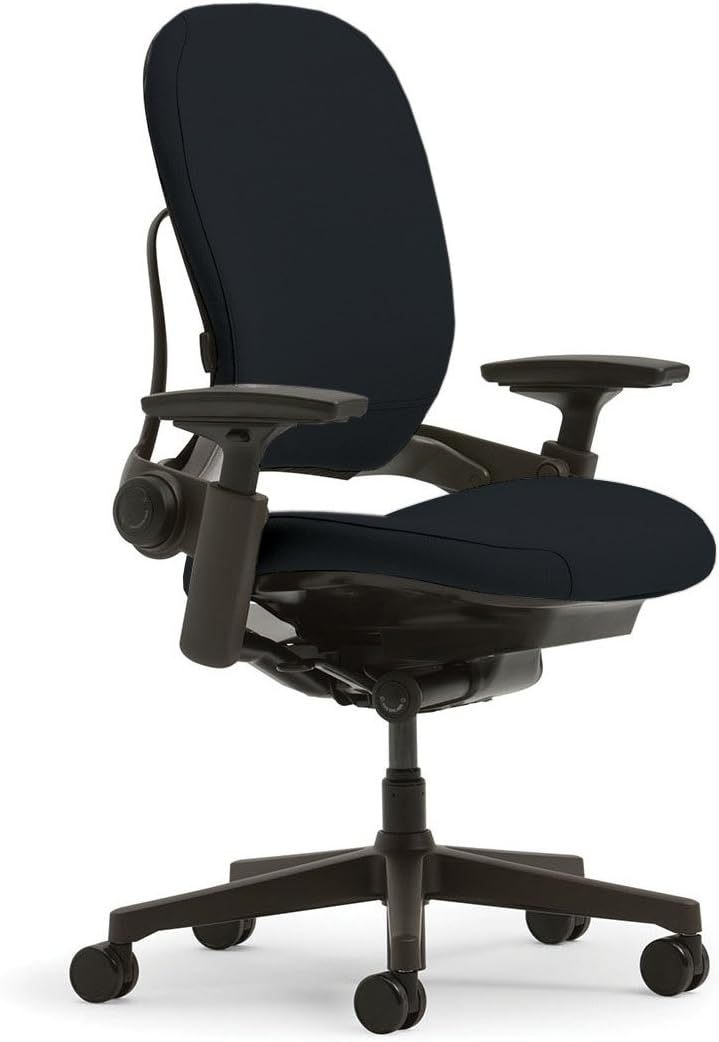
Steelcase took the opposite approach: one chair, seven points of adjustability, upholstered rather than suspended. Where the Aeron fits you by picking the right size, the Leap fits you by moving. That includes seat depth adjustment, which the Aeron does not offer at all and which matters a great deal if your leg length is unusual relative to your height — the difference between the seat edge pressing behind your knees and not.
The signature technology is 3D LiveBack, and it is genuinely clever engineering. The backrest is built to change shape as you move, mimicking the natural form of your spine and contouring to whatever position you have drifted into. Most chairs support one posture well — usually upright — and tolerate the others. The Leap is designed on the premise that you will slouch, lean, twist toward a second monitor, and sit sideways during a phone call, and that the chair should follow you through all of it. If you are a restless sitter, this is the single strongest argument for the Leap.
The Natural Glide System handles reclining differently too. On most chairs, leaning back moves you away from your desk, so you end up either sitting upright all day or craning forward from a reclined position. The Leap’s seat glides forward as the back reclines, keeping you at roughly the same distance from your keyboard. It means reclining is something you can do while working rather than only while thinking.
The lower back firmness dial is the detail people notice most in daily use — a physical control that increases or decreases how hard the lumbar section pushes into your back, independent of height adjustment. Combined with lumbar height adjustment and 4D adjustable pivot arms, it produces a chair that can genuinely be dialled to an individual body. Steelcase backs the design with over seventy years of seating research, and the Leap has been the benchmark upholstered task chair for most of two decades.
Pros
- Seven points of adjustability — fits almost any body without sizing
- 3D LiveBack changes shape as you shift position through the day
- Natural Glide System keeps you at your desk while reclining
- Lower back firmness dial adjusts lumbar pressure independently of height
- Seat depth adjustment, which the Aeron lacks entirely
- 4D adjustable pivot armrests
- Upholstered comfort rather than firm suspension
- Backed by seventy years of Steelcase seating research
Cons
- $1,399 new — more than double the Aeron
- Upholstered foam runs hotter than mesh over a long day
- Foam compresses over many years in a way suspension mesh does not
- More adjustments means more to get wrong before it feels right
- Heavier and bulkier than the Aeron
A Leap V2 in black fabric is also listed around $799 in open-box condition — substantially cheaper, but check the seller’s condition notes and return terms before buying.
Head-to-Head: Mesh Against Foam
Temperature: Aeron, Decisively
This is the least discussed and most practically important difference. The Aeron’s Pellicle suspension is an open weave — air moves through it continuously, so body heat does not accumulate between you and the chair. The Leap’s upholstered seat and back trap heat the way any cushion does. Over a two-hour meeting the difference is minor. Over an eight-hour day in a warm room it is not, and it is the single most common reason people switch from an upholstered chair to a mesh one.
Fit: Depends Entirely on Your Body
The Aeron fits by sizing — three frames, each properly proportioned for its range, with Size B covering roughly 5 feet 5 inches to 6 feet 2 inches and 150 to 230 pounds. If you fall comfortably inside that band, a Size B Aeron fits well immediately with little fiddling. The Leap fits by adjustment, including seat depth, which the Aeron does not offer. If you are at the edges of the Aeron’s ranges, have unusual proportions, or share the chair with someone of a different size, the Leap’s adjustability wins outright.
How You Sit: The Real Deciding Question
If you settle into one position and stay there, the Aeron’s firm suspension and PostureFit hold you in it beautifully. If you move constantly — and most people do more than they realize — the Leap’s 3D LiveBack is built precisely for that, changing shape to follow you rather than supporting one ideal posture. Be honest about which you are; it matters more than any specification here.
Reclining While Working: Leap
The Natural Glide System is a genuine functional advantage. Reclining in most chairs pulls you away from the desk, so you recline only when you stop working. The Leap slides the seat forward as the back goes back, keeping you within reach of the keyboard. If you like to work in a slightly reclined position — which is easier on the lower back than sitting bolt upright — this is worth real money.
Longevity: A Tie, With Different Failure Modes
Both are built to last well over a decade and both hold their resale value better than any other office chair. They age differently, though. Foam compresses; over ten or fifteen years a Leap’s cushioning is measurably softer than new. Suspension mesh does not compress, though the Pellicle can eventually lose tension. Both are repairable, both have healthy parts markets, and both regularly appear on the used market still working after fifteen years — which is the strongest endorsement either can have.
Price: Aeron, Not Close
$640 against $1,399 new is a $759 difference for two chairs of genuinely comparable quality. That is the most important fact in this comparison. The Leap offers more adjustment and a fundamentally different kind of support, but it is not twice the chair. Unless you specifically need seat depth adjustment, the LiveBack for a restless sitting style, or upholstery over mesh, the Aeron is the better value by a wide margin.
Frequently Asked Questions
Is the Herman Miller Aeron or the Steelcase Leap better?
For most people the Aeron at $640 is the better buy — it costs less than half the new Leap, its mesh suspension is dramatically cooler over a full working day, and its sized approach means a correctly chosen chair fits well immediately. The Steelcase Leap at $1,399 is better if you shift position constantly, since its 3D LiveBack changes shape to follow you, or if you need seat depth adjustment, which the Aeron does not offer at all.
What size Herman Miller Aeron should I buy?
The Aeron comes in three sizes. Size B is the middle and by far the most commonly purchased, supporting people roughly 5 feet 5 inches to 6 feet 2 inches and 150 to 230 pounds. Size A is for smaller users and Size C for larger. Getting this right matters more than any other decision, because unlike the Steelcase Leap, the Aeron cannot be adjusted to compensate for the wrong size.
Is a mesh or upholstered office chair better?
Mesh is better for temperature and long-term shape retention — air moves through it, so heat does not build up, and suspension does not compress the way foam does over a decade. Upholstery is better for initial cushioned comfort and for people who find firm suspension uncomfortable. If you work long days, run warm, or live somewhere hot, mesh is usually the right answer. If you prefer a soft seat and work in a cool room, upholstery is fine.
What is PostureFit on the Herman Miller Aeron?
PostureFit supports the sacral region at the very base of the spine, rather than pushing into the lumbar curve higher up as conventional lumbar supports do. Supporting the base of the spine holds the pelvis in the correct position, which in turn keeps the rest of the spine naturally stacked. Most people find it unusual for the first week and then find other chairs lacking without it.
Are these chairs worth over $600?
If you sit in one for a full working day, yes. Both carry twelve-year warranties and routinely remain in service after fifteen years, which works out to well under $100 a year for the Aeron. Cheaper chairs typically fail within two to four years as foam compresses and mechanisms wear, so the total cost of replacing them repeatedly often exceeds buying one good chair once. If you only sit at your desk occasionally, the case is much weaker.
Can I buy a used or open-box Steelcase Leap to save money?
Yes, and it is a common route — there is a large secondary market because corporate offices replace furniture in bulk. An open-box Leap V2 is listed around $799 against $1,399 new. Both chairs are built to be serviced and parts are widely available, so a used unit in good condition is a reasonable purchase. Check the seller’s condition notes carefully, confirm the return terms, and verify which adjustments the specific unit includes, since Leap chairs were sold in several configurations.
Final Verdict: Which Chair Should You Buy?
Buy the Herman Miller Aeron at $640. For the majority of people this is the right chair and it is the cheaper one, which makes it an easy recommendation. The Pellicle suspension keeps you cool through an eight-hour day in a way no upholstered chair manages, PostureFit addresses the base of the spine that most chairs ignore, and buying the correct size gets you a properly fitted chair without spending a week hunting for settings. Just make sure you buy the right size — Size B for roughly 5 feet 5 inches to 6 feet 2 inches and 150 to 230 pounds.
Buy the Steelcase Leap at $1,399 if you are a restless sitter. The 3D LiveBack is built to change shape as you move through a dozen positions a day, and the Natural Glide System lets you recline without leaving your keyboard behind. It is also the answer if you need seat depth adjustment, if you fall awkwardly between Aeron sizes, or if you simply prefer cushioning to suspension. If the price is the obstacle, the open-box Leap V2 around $799 closes most of the gap.
Both chairs will still be working in fifteen years. That is genuinely the standard here, and it is why either one is a better purchase than three consecutive $300 chairs.