
These two Bluetti solar generators look like the same product at slightly different prices, and they are not. The Apex 300 costs $2,499 and stores 2,764.8 watt-hours. The Elite 400 costs $2,249 — $250 less — and stores 3,840 watt-hours, which is 39% more energy. On that arithmetic alone the choice looks obvious, and it is wrong. The Apex 300 delivers 3,840 watts of output to the Elite’s 2,600, runs 120 volts and 240 volts simultaneously, and expands to 58 kilowatt-hours. One of these is a big battery; the other is a small power plant. Which you want depends entirely on whether your problem is how long the power lasts or how much of it you need at once.
Reviews Universe is reader-supported. When you buy through links on our site, we may earn an affiliate commission at no extra cost to you.
Quick Verdict
Winner for most households: the Bluetti Elite 400 at $2,249. More stored energy, less money, wheels to move it, and a 15-millisecond switchover that keeps your equipment running through an outage without noticing.
Buy the Elite 400 for home backup, camping, and general use where you want the most stored energy per dollar and the ability to move it around.
Buy the Apex 300 if you need to run 240-volt appliances, start heavy motor loads, charge an electric vehicle, or build a system you will expand over time toward whole-home backup.
Bluetti Apex 300 vs Elite 400: Specs Compared
| Bluetti Apex 300 | Bluetti Elite 400 | |
|---|---|---|
| Price (with 500W solar panel) | $2,499 | $2,249 |
| Battery capacity | 2,764.8 watt-hours | 3,840 watt-hours |
| Battery chemistry | Lithium iron phosphate | Lithium iron phosphate |
| Continuous output | 3,840 watts | 2,600 watts |
| Surge output | 7,680 watts | 3,900 watts |
| Voltage | 120V and 240V simultaneously | 120V |
| AC outlets | 6 | 9 ports total |
| Solar input | 2,400 watts with dual MPPT | 500 watt panel included |
| Solar charge speed | 80% in 40 minutes at full input | 0-100% in about 9-12 hours |
| Uninterruptible power switchover | Not specified | 15 milliseconds |
| Parallel capability | 2-3 units for 5.5-8.3 kWh | Not specified |
| Maximum expansion | 58 kWh with B300K batteries | Not specified |
| Portability | Carry handles | Easy-roll trolley system |
| In the box | Unit, 500W panel, AC cable, car cable, grounding screw | Unit, 500W panel, AC cable |
Bluetti Apex 300 — The Power Plant ($2,499)
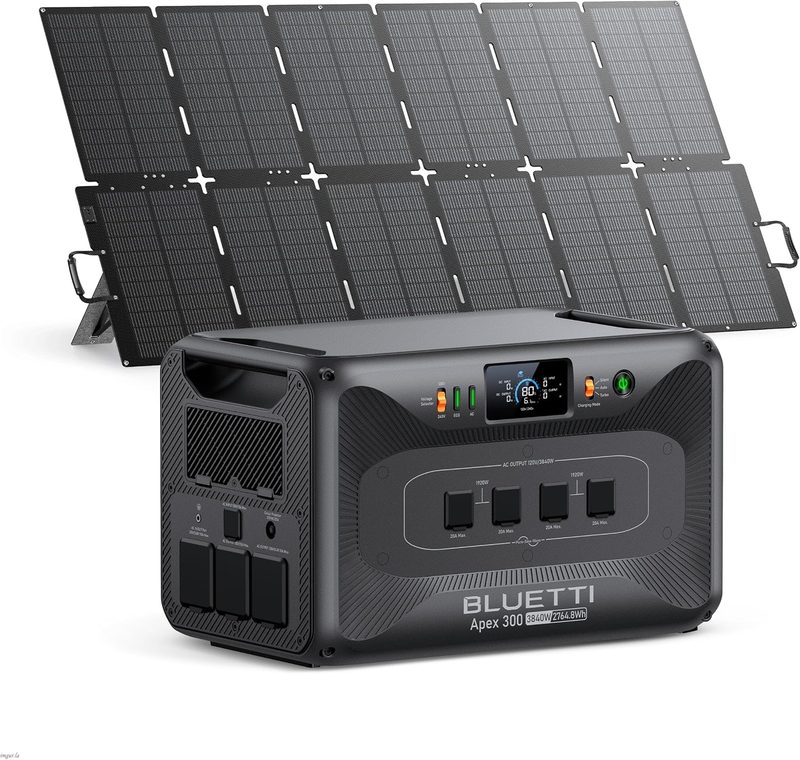
The Apex 300 is built around output rather than capacity. It delivers 3,840 watts continuously with a 7,680-watt surge, and that surge figure is the important one. Anything with a motor — a well pump, a refrigerator compressor, an air conditioner, a table saw — draws several times its running wattage for a fraction of a second at startup. A power station that cannot supply that inrush will simply refuse to start the appliance, no matter how much energy is sitting in its battery. At 7,680 watts of surge, the Apex 300 starts things the Elite 400 cannot.
The other headline capability is dual voltage. The Apex 300 outputs 120 volts and 240 volts simultaneously, which puts it in a different class of usefulness. American homes run most things at 120 volts, but the heavy loads — well pumps, electric water heaters, central air conditioning, electric vehicle chargers, some workshop tools — need 240. Most portable power stations cannot supply 240 volts at all, which quietly excludes them from exactly the loads people most want backed up. Six AC outputs let you run RV ovens and air conditioning directly without a shore hookup.
Solar charging is genuinely fast: 2,400 watts of input through dual maximum power point trackers, reaching 80% in 40 minutes at full input. That is a meaningful advantage during a multi-day outage, when the constraint is not how much you stored overnight but how fast you can refill during daylight. It works with 350-watt panels, and ships with a 500-watt panel included.
Finally, it is designed to grow. Two or three units run in parallel for 5.5 to 8.3 kilowatt-hours, and with B300K expansion batteries the system scales to 58 kilowatt-hours — genuine whole-home territory. If you are treating this as the first component of a home energy system rather than a one-off purchase, that path matters.
Pros
- 3,840 watts continuous with a 7,680 watt surge — starts heavy motor loads
- 120V and 240V simultaneous output for well pumps, air conditioning and electric vehicle charging
- Six AC outputs run RV appliances directly with no shore hookup
- 2,400 watt solar input with dual trackers reaches 80% in 40 minutes
- Parallel 2-3 units for 5.5-8.3 kWh
- Expands to 58 kWh with B300K batteries
- Lithium iron phosphate chemistry for long cycle life
- Car charging cable and grounding screw included
Cons
- $250 more than the Elite 400 for 39% less stored energy
- 2,764.8 watt-hours is modest for the price
- No trolley system — heavy to reposition
- Uninterruptible switchover time not specified
- Expansion batteries are a substantial additional cost
Bluetti Elite 400 — The Endurance Pick ($2,249)
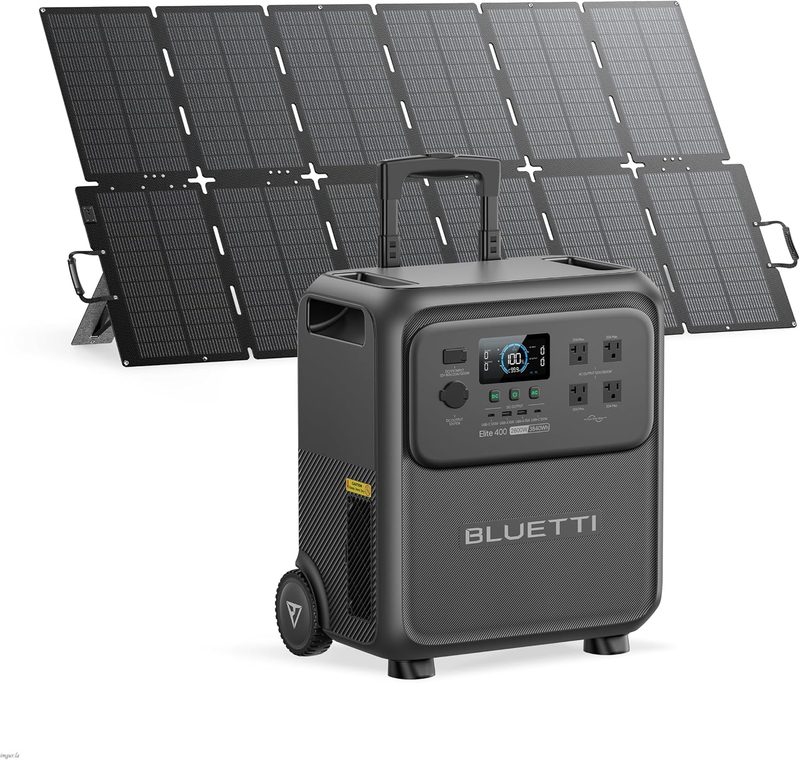
The Elite 400 stores 3,840 watt-hours, which is 39% more energy than the Apex 300 for $250 less. That is the entire argument and it is a strong one. For the overwhelming majority of uses — keeping a refrigerator, internet router, lights, laptops, and phones alive through a power cut, or running a campsite for a weekend — what you need is hours of endurance, not the ability to start a well pump. On that measure the Elite 400 is straightforwardly better value.
Output is 2,600 watts continuous with a 3,900-watt surge, which comfortably covers a refrigerator, a microwave, power tools, and everything in a normal household that is not a 240-volt appliance. Nine ports handle the mix of devices you would realistically plug in.
Two practical features distinguish it. First, the easy-roll trolley system: this is a heavy object, and wheels plus a handle are the difference between a unit that lives where you can use it and one that stays in the basement because moving it is a two-person job. For camping, tailgating, or shifting between the garage and the house during an outage, this matters more than a specification sheet suggests.
Second, the 15-millisecond switchover. When mains power fails, the Elite 400 takes over fast enough that connected equipment never registers the interruption — Wi-Fi routers stay online, security cameras keep recording, desktop computers do not reboot, pet feeders do not lose their schedules. That is uninterruptible power supply behavior, and it means the Elite 400 protects against brief flickers as well as long outages.
Charging from the included 500-watt solar panel takes roughly 9 to 12 hours for a full 0 to 100% cycle. That is a full day of good sun — slower than the Apex 300’s aggressive solar input, and the main practical trade-off for the larger battery.
Pros
- 3,840 watt-hours — 39% more stored energy than the Apex 300
- $250 cheaper than the Apex 300
- 15 millisecond switchover keeps routers, cameras and computers running through outages
- Easy-roll trolley system makes a heavy unit genuinely movable
- Nine ports cover a realistic household device mix
- 2,600 watts continuous handles refrigerators, microwaves and power tools
- Lithium iron phosphate chemistry for long cycle life
- 500 watt solar panel included
Cons
- No 240 volt output — cannot run well pumps, electric water heaters or car chargers
- 3,900 watt surge will not start the heaviest motor loads
- 9-12 hours for a full solar recharge
- No stated parallel or expansion path
- 2,600 watts continuous is well below the Apex 300’s 3,840
Head-to-Head: Capacity Against Power
Understanding Watt-Hours vs Watts
These two numbers get confused constantly and they decide this comparison. Watt-hours measure how much energy is stored — how long the unit runs. Watts measure how fast it can deliver that energy — what it can run at all. A 150-watt refrigerator draws 150 watts continuously, so the Elite 400’s 3,840 watt-hours would run it for roughly 25 hours against the Apex 300’s 18. But that same refrigerator might draw 1,200 watts for a fraction of a second when its compressor starts. If a unit cannot supply that inrush, the fridge never starts and the stored energy is irrelevant. Capacity is endurance; output is capability. You need enough of both, and which you need more of depends on what you are plugging in.
Running Time: Elite 400
39% more stored energy for $250 less is decisive for anyone whose priority is riding out a long outage. In a typical backup scenario — refrigerator, a few lights, router, phone and laptop charging — the Elite 400 simply lasts substantially longer, and lasting longer is usually the whole point.
Heavy Loads and 240 Volts: Apex 300
This is not a matter of degree. The Apex 300 supplies 240 volts and the Elite 400 does not, which means an entire category of appliance is either supported or not. Well pumps, electric water heaters, central air conditioning, and electric vehicle chargers all need 240 volts. If any of those is on your backup list, the comparison is already settled and the Elite 400’s larger battery is irrelevant. The same applies to the 7,680-watt surge against 3,900 — some things simply will not start on the smaller unit.
Recharging: Apex 300
2,400 watts of solar input reaching 80% in 40 minutes against roughly 9 to 12 hours for a full charge is a large difference, and it matters most in exactly the scenario people buy these for: a multi-day outage where you are cycling the battery daily. Fast solar input effectively multiplies your usable energy, because you refill during the day and spend at night. The catch is that hitting 2,400 watts requires substantially more solar panel than the 500-watt panel included in either bundle.
Living With Them: Elite 400
Wheels and a 15-millisecond switchover are unglamorous and genuinely change daily use. The trolley means the unit gets moved and used rather than left in place. The near-instant switchover means it functions as an uninterruptible power supply for sensitive electronics, protecting against the brief flickers that reboot computers, not just the long outages you plan for.
Growing the System: Apex 300
If you view this as the start of a home energy system, only the Apex 300 offers a route: two or three units in parallel for 5.5 to 8.3 kilowatt-hours, and expansion to 58 kilowatt-hours with B300K batteries. That upper figure is real whole-home backup. Reaching it costs a great deal more, but the architecture exists.
Frequently Asked Questions
Should I buy the Bluetti Apex 300 or the Elite 400?
Buy the Elite 400 at $2,249 for most situations — it stores 3,840 watt-hours against the Apex 300’s 2,764.8, costs $250 less, has a trolley for moving it, and switches over in 15 milliseconds so connected electronics never notice an outage. Buy the Apex 300 at $2,499 only if you need 240-volt output for appliances like well pumps, electric water heaters or vehicle charging, need its 7,680-watt surge to start heavy motors, or intend to expand toward whole-home backup.
What is the difference between watt-hours and watts on a power station?
Watt-hours measure stored energy — how long the unit can run something. Watts measure output — how much it can power at one time. A 3,840 watt-hour battery running a 150-watt refrigerator lasts roughly 25 hours. But if that refrigerator briefly draws 1,200 watts when its compressor starts, a unit with insufficient surge output will not start it at all, regardless of capacity. You need enough capacity for your runtime and enough output for your heaviest load.
Can a portable power station run a well pump or an air conditioner?
Only if it supplies 240 volts and enough surge power. Well pumps, electric water heaters, central air conditioning and electric vehicle chargers in American homes typically run at 240 volts, and most portable power stations only output 120. The Bluetti Apex 300 outputs 120V and 240V simultaneously with a 7,680-watt surge, which covers these loads. The Elite 400 is 120-volt only and cannot run them at any capacity.
What does LFP battery chemistry mean and why does it matter?
LFP stands for lithium iron phosphate, and both of these units use it. Compared with the lithium-ion chemistry in phones and laptops, LFP cells last far longer — typically thousands of charge cycles rather than hundreds — and are considerably more thermally stable, meaning much lower fire risk. For a large battery that lives in your home and gets cycled regularly for years, both properties matter a great deal. LFP is the correct chemistry for this application and its use here is a mark in favor of both units.
How long does it take to recharge these power stations from solar?
The Bluetti Elite 400 takes roughly 9 to 12 hours to charge from 0 to 100% using the 500-watt solar panel included in the bundle — effectively a full day of good sun. The Apex 300 accepts up to 2,400 watts of solar input through dual trackers and can reach 80% in 40 minutes at that full input, but achieving 2,400 watts requires substantially more panel capacity than the 500-watt panel included in the box.
Is a solar generator better than a gas generator for home backup?
For most household backup, yes. A solar generator runs silently, produces no exhaust so it can be used indoors safely, needs no fuel storage, and requires almost no maintenance. A gas generator produces far more sustained power for less money and can run indefinitely as long as you keep feeding it fuel. The practical dividing line is duration and load: for keeping a fridge, lights and electronics running through an outage of a day or two, a battery is better in every way that matters. For powering a whole house for a week, gas still wins.
Final Verdict: Which Bluetti Should You Buy?
Buy the Bluetti Elite 400 at $2,249. For the majority of buyers this is both the cheaper and the better product, which does not happen often. 3,840 watt-hours is 39% more stored energy than the Apex 300 for $250 less, the trolley system means you will actually move and use it, and the 15-millisecond switchover turns it into an uninterruptible power supply for everything sensitive in your house. For home backup, camping, and general-purpose use, it is the clear answer.
Buy the Bluetti Apex 300 at $2,499 if your requirements include anything the Elite 400 physically cannot do. That means 240-volt appliances — well pumps, electric water heaters, central air conditioning, vehicle charging — or heavy motor loads needing its 7,680-watt surge, or a plan to expand toward 58 kilowatt-hours of whole-home backup. In those cases the larger battery in the cheaper unit is no help at all, because it will not start the load in the first place.
The practical way to decide: write down the appliances you actually intend to run, find the highest starting wattage among them, and check whether any require 240 volts. That list answers this question faster than any specification comparison.
On a smaller budget, the Bluetti Elite 300 ($2,049) offers 3,014.4 watt-hours with 2,400 watt output and the same 500 watt solar panel.