
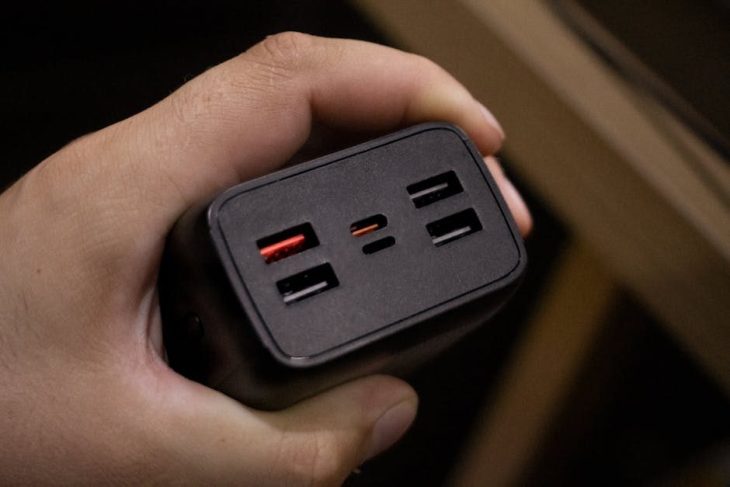
Whether you need to charge a MacBook on a flight or just keep your phone alive through a long day, a good power bank is essential tech in 2026. The problem is sorting through hundreds of options with confusing specs. We tested the top portable chargers to find the best power bank for every budget and use case.
Reviews Universe is reader-supported. When you buy through links on our site, we may earn an affiliate commission at no extra cost to you.
| Product | Best For | Price | Buy |
|---|---|---|---|
| Anker Prime 26K (300W) | Best Premium | $170 | Check Price → |
| INIU 45W 20,000mAh | Best Budget | $36 | Check Price → |
| Baseus Adaman 20,000mAh 65W | Best Value for Laptops | $40 | Check Price → |
| UGREEN Nexode 25,000mAh 200W | Best High-Power | $80 | Check Price → |
| Anker PowerCore Slim 10,000mAh | Best Ultra-Budget | $22 | Check Price → |
1. Anker Prime 26K (300W) — Best Premium ($170)
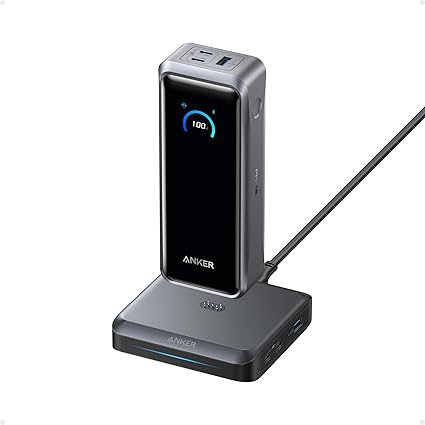
The Anker Prime 26K is the most powerful portable power bank we’ve tested in 2026. With 300W of maximum output, it can charge two MacBook Pros simultaneously — something no other TSA-approved power bank on this list can match. If you travel with multiple devices, this is the one.
The 26,250mAh capacity sits just under the TSA’s 100Wh airline limit, so you can fly with it without issues. It packs two USB-C ports and one USB-A port, delivering enough wattage to fast-charge a MacBook Air from 0-50% in under 30 minutes while topping off your phone at the same time.
Anker’s companion app gives you real-time stats on power draw, remaining capacity, and charging history — a nice touch for power users. The build is solid aluminum with a compact form factor considering the output. At $170 on sale (down from $200), it’s not cheap, but for anyone who needs to power laptops on the go, it’s worth every dollar.
Pros
- 300W max output — charges two MacBooks at once
- 26,250mAh, TSA-approved (under 100Wh)
- 2x USB-C + 1x USB-A ports
- App control with real-time power stats
- Premium aluminum build quality
Cons
- $170 is expensive for a power bank
- Heavy at 1.56 lbs (708g)
- 300W requires Anker’s own cable for max speed
- Overkill if you only charge phones
2. INIU 45W 20,000mAh — Best Budget ($36)

The INIU 45W is the best power bank under $50, period. At just $36, you get 20,000mAh of capacity with 45W PD fast charging — enough to charge an iPhone 16 about four times and fast enough to meaningfully top up an iPad or even a lightweight laptop in a pinch.
What makes the INIU stand out from other budget options is the built-in USB-C cable. No more fishing around for a charging cable in your bag — just flip out the integrated cord and plug in. It also has an LED display showing exact battery percentage, which is far more useful than the four-dot LED indicators on most cheap power banks.
The 45W output is enough for fast-charging most flagship phones at their maximum input speed. It won’t fully power a MacBook, but it will slow-charge one in an emergency. At this price, the INIU delivers features that were exclusive to $80+ power banks just a year ago.
Pros
- 45W PD fast charging for just $36
- Built-in USB-C cable — no cable needed
- LED display shows exact battery percentage
- 20,000mAh charges an iPhone 4x
- Compact for the capacity
Cons
- 45W isn’t enough for full-speed laptop charging
- Built-in cable adds slight bulk
- USB-A port is slow (only 5W)
- No wireless charging
3. Baseus Adaman 20,000mAh 65W — Best Value for Laptops ($40)
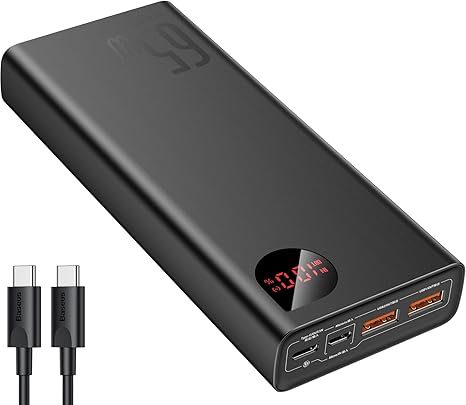
The Baseus Adaman is the cheapest power bank we’ve found that can genuinely charge a laptop. At $40, its 65W USB-C output is enough to power a MacBook Air, Dell XPS 13, or ThinkPad X1 Carbon at full speed — the same wattage as their included chargers.
You get four ports total: two USB-C and two USB-A. This means you can charge your laptop and three other devices simultaneously. The 20,000mAh capacity gives you roughly one full MacBook Air charge or about 3.5 iPhone charges (accounting for conversion efficiency).
The transparent design with built-in digital display looks premium and shows real-time wattage and remaining capacity. Build quality is solid, though at 460g it’s heavier than phone-only power banks. For anyone who needs laptop charging under $50, the Baseus Adaman is the undisputed value champion.
Pros
- 65W USB-C output — genuine laptop charging for $40
- 4 ports (2x USB-C + 2x USB-A)
- Digital display with real-time wattage
- Transparent design looks premium
- Can charge laptop + 3 devices simultaneously
Cons
- 460g is heavier than phone-only banks
- Only one port outputs 65W at a time
- 20,000mAh gives roughly one laptop charge
- No built-in cables
4. UGREEN Nexode 25,000mAh 200W — Best High-Power ($80)
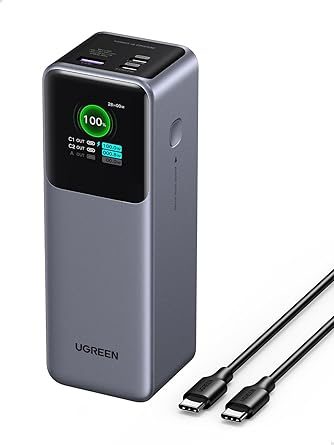
The UGREEN Nexode sits in the sweet spot between the budget options and the Anker Prime. At $80, it delivers 200W total output with dual 100W USB-C ports — enough to fast-charge two laptops at once, or a laptop and a phone at maximum speed.
What sets it apart is PD 3.1 support, which means it can deliver 100W per USB-C port. That’s the same wattage as a MacBook Pro’s wall charger. The 25,000mAh capacity is close to the TSA’s 100Wh limit, giving you maximum portable power for flights.
The TFT smart display is the best on this list — a color screen showing port-by-port power draw, remaining capacity, and estimated time to empty. It’s genuinely useful when you’re managing multiple devices. UGREEN also includes a 65W self-recharge speed, so the bank itself fills up in about 90 minutes.
Pros
- 200W total with dual 100W USB-C ports
- PD 3.1 for true laptop-speed charging
- TFT color display with per-port stats
- 25,000mAh near-max airline capacity
- 65W self-recharge in ~90 minutes
Cons
- $80 is mid-range pricing
- Heavy at 590g
- USB-A port is slower (22.5W max)
- No companion app like the Anker Prime
5. Anker PowerCore Slim 10,000mAh — Best Ultra-Budget ($22)
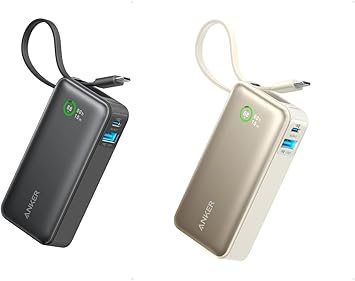
Sometimes you just need a power bank that fits in your pocket and keeps your phone alive. The Anker PowerCore Slim 10,000mAh does exactly that for just $22 — and it does it well.
At 0.5 inches thin and under 8 ounces, this is the most pocketable power bank on the list. It slides into a back pocket or jacket without creating a bulge. The 10,000mAh capacity gives you roughly two full iPhone charges or one and a half Samsung Galaxy charges.
You get one USB-C port (20W PD) and one USB-A port (12W). The USB-C port supports Power Delivery, so it fast-charges iPhones and most Android phones. It won’t charge a laptop, but that’s not the point — this is the power bank you grab when you want reliable phone charging without the bulk.
Pros
- Just $22 — cheapest on this list
- Ultra-slim pocketable design (0.5 inches thin)
- USB-C PD (20W) + USB-A (12W)
- 10,000mAh for ~2 full iPhone charges
- Anker’s proven reliability and warranty
Cons
- 10,000mAh limits total charges
- 20W max — no laptop charging
- No display (4-LED indicator only)
- No built-in cable
- Slower self-recharge speed
Side-by-Side Comparison
| Anker Prime 26K | INIU 45W | Baseus Adaman | UGREEN Nexode | PowerCore Slim | |
|---|---|---|---|---|---|
| Price | $170 | $36 | $40 | $80 | $22 |
| Capacity | 26,250mAh | 20,000mAh | 20,000mAh | 25,000mAh | 10,000mAh |
| Max Output | 300W | 45W | 65W | 200W | 20W |
| USB-C Ports | 2 | 1 + built-in cable | 2 | 2 (100W each) | 1 |
| USB-A Ports | 1 | 1 | 2 | 1 | 1 |
| Laptop Charging | Yes (2 laptops) | Slow only | Yes (65W) | Yes (2 laptops) | No |
| Display | LED + App | LED percentage | Digital display | TFT color | 4 LEDs |
| Weight | 708g | ~400g | 460g | 590g | ~210g |
| TSA Approved | Yes | Yes | Yes | Yes | Yes |
How to Choose the Right Portable Power Bank
Capacity Explained: mAh vs. Real-World Charges
Milliamp-hours (mAh) is the standard capacity measurement, but it’s misleading. A 20,000mAh power bank won’t deliver 20,000mAh to your device due to voltage conversion losses and heat. In practice, expect about 70% efficiency — so a 20,000mAh bank delivers roughly 14,000mAh of usable power.
For reference: an iPhone 16 has a ~3,561mAh battery. A 20,000mAh power bank gives you roughly 3.5-4 full charges (not the 5.6x the math suggests). For a MacBook Air (52.6Wh), a 20,000mAh / 74Wh bank gives roughly one full charge.
Wattage Matters: Why 65W+ for Laptops
Wattage determines charging speed. Here’s what you need by device type:
- Phones: 20-30W for fast charging (most phones max out at 25-45W)
- Tablets: 30-45W for fast charging
- Laptops: 65W minimum for real-time charging (100W+ for MacBook Pro 16-inch)
A 45W power bank can technically charge a laptop, but the laptop may drain faster than it charges under heavy use. For reliable laptop charging, we recommend 65W or higher.
Port Types: USB-C PD vs. USB-A
USB-C with Power Delivery (PD) is the gold standard in 2026. It handles the highest wattage and works with laptops, tablets, and phones. USB-A is limited to lower wattage (typically 5-18W) and is mainly useful for older accessories like earbuds or smartwatches.
Look for power banks with at least one USB-C PD port. If you carry multiple devices, two USB-C ports give you much more flexibility than one USB-C and one USB-A.
TSA Airline Limits: 100Wh / ~27,000mAh
Airlines allow power banks up to 100 watt-hours (Wh) in carry-on luggage without approval. This translates to roughly 27,000mAh at 3.7V. All five power banks on our list are TSA-approved. Power banks are never allowed in checked baggage.
Banks between 100-160Wh require airline approval and are limited to two per passenger. Above 160Wh is prohibited on all flights.
Real-World Efficiency: The 70% Rule
Always apply the 70% rule when estimating charges. Voltage conversion (from the bank’s 3.7V to your device’s 5V+), cable resistance, and heat all reduce usable output. Premium power banks with newer chips (like the Anker Prime) achieve closer to 80% efficiency, while budget options may drop to 65%.
Frequently Asked Questions
How many times can a 20,000mAh power bank charge an iPhone?
A 20,000mAh power bank can charge an iPhone 16 approximately 3.5-4 times. The calculation isn’t simply dividing capacities because of voltage conversion losses. Expect about 70% of the rated capacity to reach your device — so 20,000mAh delivers roughly 14,000mAh of usable power to a ~3,561mAh iPhone battery.
Can I bring a power bank on a plane?
Yes, but only in carry-on luggage. The TSA and most international airlines allow power banks up to 100Wh (roughly 27,000mAh) without any special approval. Banks between 100-160Wh require airline approval. Power banks above 160Wh and all power banks in checked baggage are prohibited. All five power banks on our list are under 100Wh and TSA-approved.
What wattage do I need for laptop charging?
For reliable laptop charging, you need at least 65W. A MacBook Air charges fully at 67W, a Dell XPS 13 at 65W, and a MacBook Pro 16-inch at 140W. The Baseus Adaman (65W, $40) is the cheapest option for laptop charging. The UGREEN Nexode (200W) and Anker Prime (300W) can charge even power-hungry gaming laptops.
How long does a power bank last?
A quality power bank lasts 500+ charge cycles before capacity degrades noticeably — that’s roughly 3-5 years of regular use. Lithium-polymer batteries (used in most modern power banks) retain about 80% of their capacity after 500 cycles. Store your power bank at 40-60% charge when not in use for maximum lifespan.
What’s the difference between PD and QC?
PD (Power Delivery) and QC (Quick Charge) are both fast-charging protocols, but PD is the universal standard in 2026. PD works over USB-C and supports up to 240W, powering everything from phones to laptops. QC (by Qualcomm) maxes out at 100W and works over both USB-C and USB-A. Most modern devices support PD. If your device supports both, PD is generally preferred.
The Verdict: Which Power Bank Should You Buy?
For most people, the Baseus Adaman 20,000mAh 65W is the best portable power bank. At $40, it’s the cheapest option with genuine laptop charging, four ports, and a quality display. It covers phones, tablets, and laptops — the entire range of devices most people carry.
If you need maximum power for multiple laptops, the Anker Prime 26K at $170 is unmatched. For the best budget option under $40, the INIU 45W at $36 delivers excellent value with a built-in cable. The UGREEN Nexode at $80 is the sweet spot for power users who need dual 100W USB-C. And for pocketable simplicity, the Anker PowerCore Slim at $22 is the grab-and-go champion.