
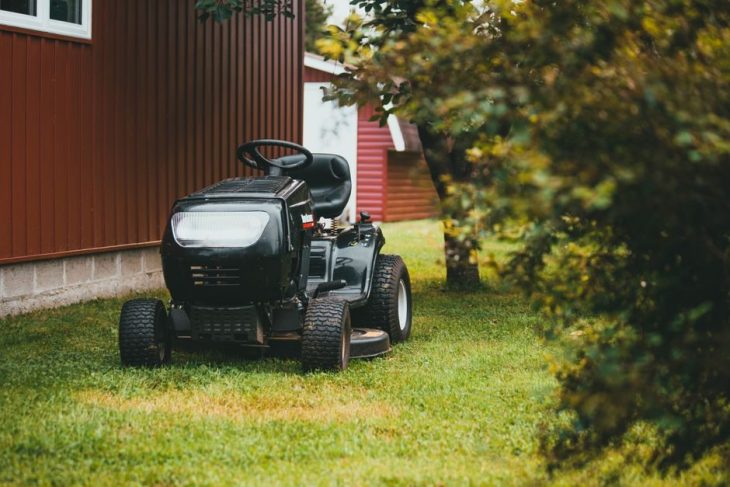
Robot lawn mowers spent a decade being a bad idea executed poorly. You buried a boundary wire around your garden, the mower bumped into things until it found its way home, and it cost as much as a used car. In 2026 that description is obsolete. The current generation navigates with spinning laser scanners and stereo cameras, needs no wire at all, climbs slopes steep enough to be genuinely difficult to walk up, and recognizes hundreds of object types so it drives around the garden hose instead of eating it. Prices still start around $1,800 and run past $3,000 — but against several years of lawn service invoices, the arithmetic has changed. These are the five worth buying.
Reviews Universe is reader-supported. When you buy through links on our site, we may earn an affiliate commission at no extra cost to you.
| Product | Price | Buy |
|---|---|---|
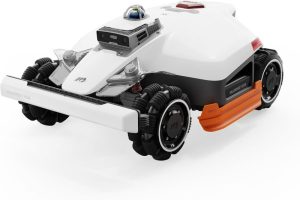 Mammotion Luba 3 AWD 3000H Best Overall |
$2,799 | Check Price |
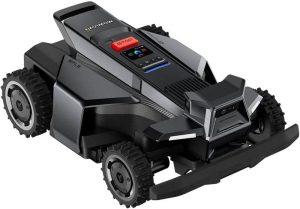 Segway Navimow X430 Best for Large Yards |
$2,249 | Check Price |
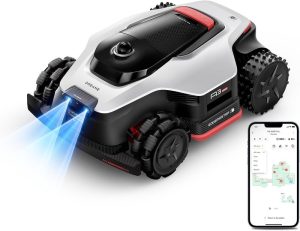 Dreame A3 AWD Pro 3500 Fastest Coverage |
$2,700 | Check Price |
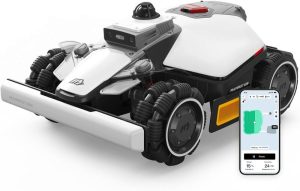 Mammotion Luba mini 2 AWD Best for Small Yards |
$1,999 | Check Price |
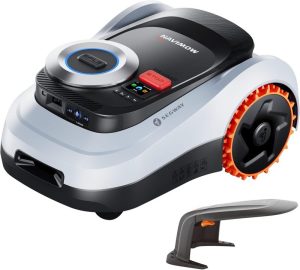 Segway Navimow i215 LiDAR Best Value |
$1,849 | Check Price |
1. Mammotion Luba 3 AWD 3000H — Best Overall ($2,799)
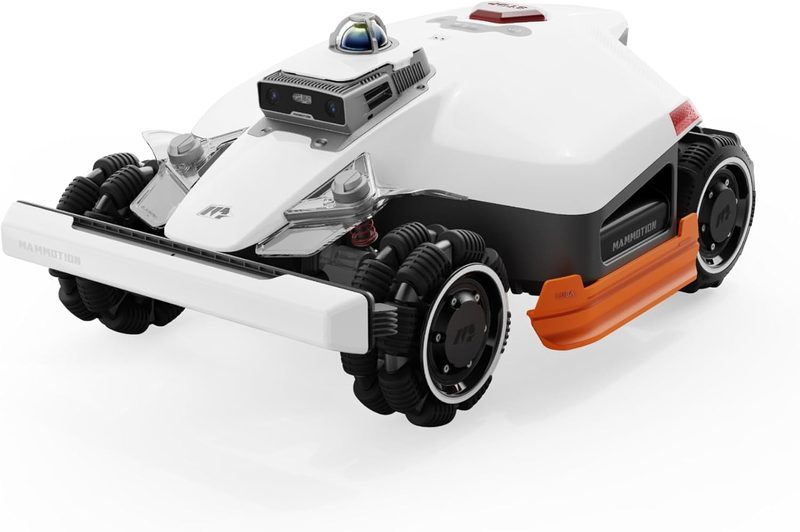
The Luba 3 AWD 3000H is the most complete robot mower on sale, and the reason is that Mammotion refused to pick a navigation technology. Its Tri-Fusion system runs three at once: a 360-degree laser scanner, network-corrected satellite positioning, and dual-camera artificial intelligence vision. Each covers the others’ weaknesses. Satellite positioning fails under tree cover and next to buildings; the laser scanner does not care about sky visibility; the cameras identify what an obstacle actually is. The mower switches between them intelligently as conditions change, which is why it holds a position in the awkward corners of a garden where single-technology mowers drift or stall.
The laser scanner itself is serious hardware — a 360-degree horizontal and 59-degree vertical field of view with a range up to 230 feet, generating millions of returns into a live point cloud that maps everything from ground level up to the tree canopy. The upgraded processor doubles the previous generation’s perception speed and identifies more than 300 obstacle types, calculating a path around them in real time rather than stopping and reversing.
Mechanically it is an all-wheel-drive machine with four independent motors, climbing slopes up to 80% — that is 38.6 degrees, steep enough that walking it is genuinely unpleasant. An adaptive suspension system steps over curbs, roots, and thresholds up to 50 millimeters. Cutting comes from two high-torque 165-watt motors driving six-blade discs, with the vision system adjusting speed and power automatically based on how dense the grass is. Runtime is up to 175 minutes on the 12 amp-hour battery, covering roughly 500 square meters per hour, across up to 30 separately managed zones. Cutting height adjusts from 2.2 to 4.0 inches.
It handles up to 0.75 acres. If your garden is bigger than that, look at the Navimow X430 or the Dreame instead.
Pros
- Tri-Fusion navigation runs laser scanning, satellite positioning and camera vision simultaneously
- 360-degree laser scanner with 230 foot range builds a dense live map
- Recognizes over 300 obstacle types with doubled processing speed
- All-wheel drive with four motors climbs 80% (38.6 degree) slopes
- Steps over obstacles up to 50 millimeters on adaptive suspension
- Dual 165-watt cutting motors adapt to grass density automatically
- Up to 30 mowing zones with four selectable cutting patterns
Cons
- $2,799 is a serious investment
- Limited to 0.75 acres — not enough for the largest properties
- Complex multi-sensor system means more that can eventually fail
- The garage is a separate purchase
- Overkill for a small, flat, simple lawn
2. Segway Navimow X430 — Best for Large Yards ($2,249)
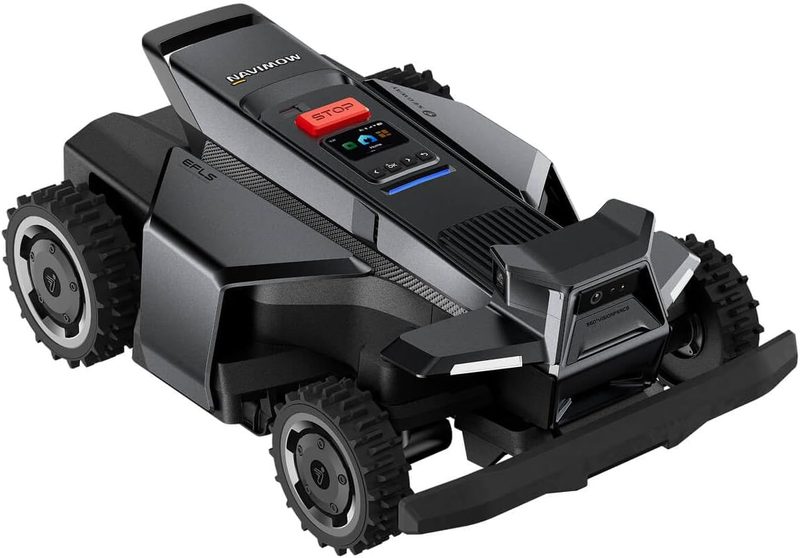
The Navimow X430 covers up to a full acre and it is the cheapest mower here that does. It is also the best-engineered machine on this list from a purely mechanical standpoint. Segway applied its off-road vehicle experience to a dual suspension system that handles broken ground properly, and the result climbs 84% slopes — 40 degrees, the steepest figure in this group — while crossing obstacles up to 2.8 inches.
The genuinely clever engineering is the steering. Zero-turn mowers pivot in place, which is efficient but tears turf, because one wheel is dragging sideways across grass. Segway’s Xero-Turn system uses eccentric front-wheel steering with traction control to deliver the maneuverability of a zero-turn without scuffing your lawn. On a mower that will run across the same ground hundreds of times a season, that detail matters more than it sounds.
Cutting is handled by two 180-watt motors — the most powerful here — driving dual discs with 12 blades across a 17-inch cutting width. That combination is what lets it cover an acre in reasonable time, and the EdgeSense system trims to within under 2 inches of borders, which substantially reduces the strimming you have to do yourself. Cutting height ranges from 0.75 to 4 inches, the widest range in this group.
Navigation uses tri-frequency network satellite correction combined with 360-degree vision and visual-inertial odometry for centimeter accuracy even under trees, with VisionFence recognizing over 200 obstacle types. Setup is a single tap of auto mapping with no antenna to install, and it takes voice commands through Amazon Alexa and Google Home.
Pros
- Covers up to 1 acre — the largest area at this price
- Climbs 84% (40 degree) slopes, the steepest here
- Off-road-tuned dual suspension crosses 2.8 inch obstacles
- Xero-Turn steering gives zero-turn agility without scuffing turf
- Dual 180-watt motors and a 17 inch cutting width — the most cutting power here
- EdgeSense trims to under 2 inches from borders
- Voice control through Amazon Alexa and Google Home
- Widest cutting height range at 0.75 to 4 inches
Cons
- Recognizes 200 obstacle types where the Mammotion manages 300
- No laser scanner — relies on satellite positioning and vision
- Large machine that needs real storage space
- Satellite-based navigation is more affected by heavy tree cover
3. Dreame A3 AWD Pro 3500 — Fastest Coverage ($2,700)
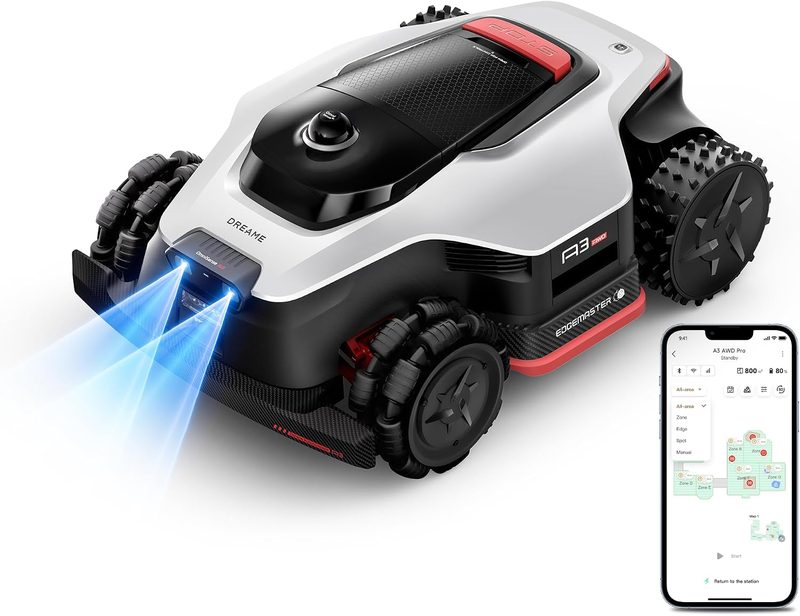
The Dreame A3 AWD Pro handles the largest area on this list — 0.87 acres — and it is built around getting through that area quickly. Dual floating cutting discs give a 15.8-inch cutting width, and a dedicated Rush mode pushes coverage to 8,611 square feet per hour. For a large lawn that needs cutting on a schedule rather than continuously, that speed is the specification that matters most.
Navigation is Dreame’s OmniSense 3.0, pairing a 360-degree three-dimensional laser scanner with binocular artificial intelligence vision, detecting at up to 240 feet — the longest range here — and avoiding more than 300 obstacle types. Dreame is explicit about why this beats satellite-only systems: traditional satellite-corrected mowers lose signal near trees, fences, and houses, while laser scanning simply does not depend on the sky.
Four-wheel-drive hub motors climb 38.7-degree (80%) slopes with off-road wheels that hold traction in thick or damp grass, and the suspension clears roots, curbs, and thresholds up to 2.2 inches. Cutting height adjusts from 1 to 4 inches through the app — the lowest minimum here — and it will chew through overgrown grass up to 8 inches tall, which is genuinely useful if you inherit a neglected lawn or return from holiday.
The zone management is the most generous of any mower here: 100 zones, 100 no-go areas, and 50 paths. Security is also the most thorough, combining 24/7 yard monitoring with human detection alerts, satellite tracking, and a 4G connection so the mower stays reachable even if your home network drops. Operation is quiet enough to schedule overnight.
Pros
- Covers 0.87 acres, the largest area here
- Rush mode cuts up to 8,611 square feet per hour
- 240 foot detection range, the longest on this list
- Laser scanning plus binocular vision works where satellite positioning fails
- Cuts grass up to 8 inches tall and down to a 1 inch height
- 100 zones, 100 no-go areas and 50 paths
- 4G connectivity and satellite tracking with human detection alerts
- Quiet enough for scheduled overnight mowing
Cons
- $2,700 with no included garage
- Cutting width narrower than the Segway X430’s 17 inches
- The 4G security features may depend on an ongoing data connection
- Large and heavy to move or store
4. Mammotion Luba mini 2 AWD 1500H — Best for Small Yards ($1,999)
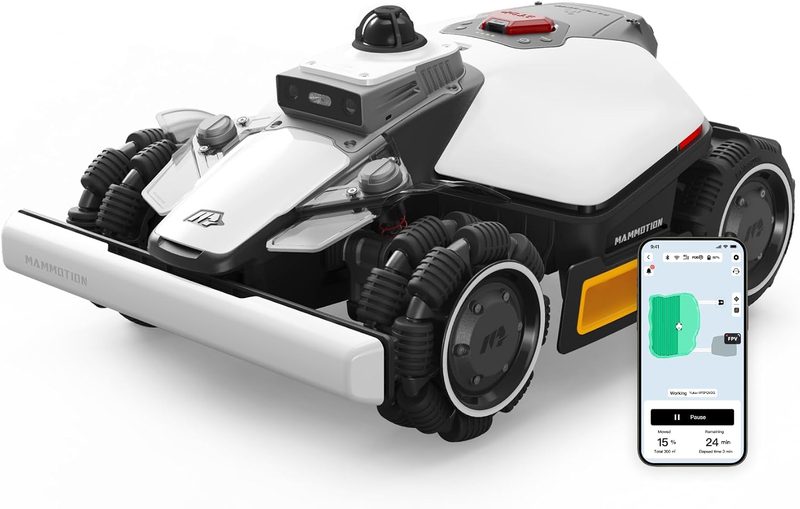
The Luba mini 2 AWD is the 2026 small-garden version of the flagship, covering 0.37 acres and shipping with the garage included — which the full-size Luba 3 does not. It keeps the 360-degree laser scanner and dual-camera vision, at a 360 by 45 degree field of view, with a high-performance processor handling recognition. Mammotion is clear that the dual-sensor redundancy substantially improves obstacle detection over the previous generation, spotting distant objects earlier so the mower plans around them instead of stopping.
Despite the smaller size it keeps the 80% climbing ability, driven by two independent 88-watt motors with an omni wheel for clean pivots, and the adaptive suspension steps over obstacles up to 45 millimeters. The cutting arrangement is the most thoughtful here: a main cutting disc plus a dedicated edge cutting disc, so when it runs along a border with lawn on one side and paving on the other, the side blade finishes the edge cleanly. The main disc adjusts cutting height automatically through the app.
Two features stand out as genuinely well designed. DropMow mode lets you set the mower down anywhere, press start, and have it cut based on its current orientation without building or saving a map — perfect for a one-off job in an area you have not mapped. And the battery management lets you cap charging at, say, 80% to preserve long-term battery health, only topping to 100% before a scheduled run, with off-peak charging so it draws power during cheaper hours.
Coverage per charge is up to 350 square meters, a 40% improvement over the previous generation, across up to 20 zones.
Pros
- Garage included, unlike the full-size Luba 3
- Keeps 360-degree laser scanning and dual-camera vision from the flagship
- Dedicated edge cutting disc finishes borders cleanly
- Climbs 80% slopes despite the smaller frame
- DropMow mode cuts unmapped areas with no setup
- Battery charge limiting and off-peak charging protect the battery and cut running costs
- Automatic cutting height adjustment through the app
Cons
- Only covers 0.37 acres
- 88-watt motors are much less powerful than the flagship’s 165-watt units
- 20 zones rather than the Luba 3’s 30
- $1,999 is still a lot for a small garden
- Steps over 45 millimeter obstacles, slightly less than the full-size model
5. Segway Navimow i215 LiDAR — Best Value ($1,849)
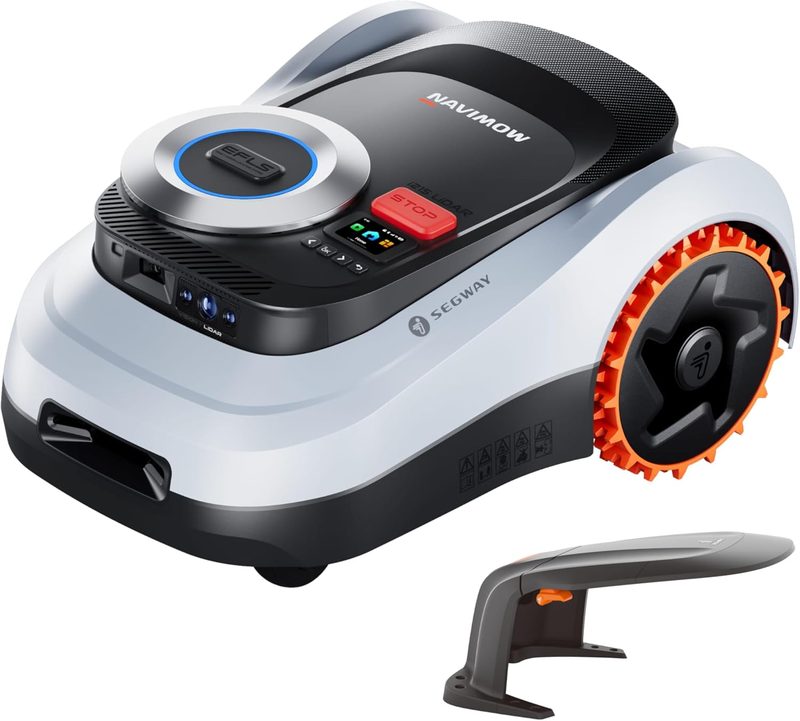
The Navimow i215 is the cheapest mower here with a proper laser scanner, and that makes it the value pick. It uses a high-resolution solid-state laser scanner paired with vision sensors for navigation that works without any satellite signal at all — reliably, day or night, with genuine three-dimensional awareness. Solid-state means no spinning turret, which is one fewer moving part to fail.
Obstacle detection identifies over 200 types with 0.4-inch accuracy, and you can edit up to 20 mowing zones on an interactive map in the app. EdgeSense handles clean cutting along fences and paths. Setup is genuinely drop-and-mow: no boundary wires, no antenna, one tap to map, with Amazon Alexa and Google Home voice control.
The compromises are honest ones. It climbs 45% slopes rather than the 80%+ of the flagships — fine for a gently sloping garden, not enough for a genuine hillside. The single 100-watt motor drives a six-blade disc with a 7.1-inch cutting width, which is less than half the Segway X430’s 17 inches, so it takes considerably longer to cover the same ground. Cutting height runs from 2 to 4 inches. Coverage is 0.37 acres.
What you still get is the full modern feature set: satellite tracking, geo-fencing, lift detection, Apple Find My integration, automatic docking when the weather turns, and an in-app tool for drawing custom mowing patterns into the lawn. For a normal suburban garden without dramatic terrain, this is the sensible purchase and it saves $400 to $950 against everything above it.
Pros
- Cheapest mower here with a genuine laser scanner
- Solid-state scanner has no spinning parts to wear out
- Navigates with no satellite signal at all, day or night
- Detects 200+ obstacle types to 0.4 inch accuracy
- Garage included, plus Apple Find My, geo-fencing and lift detection
- Auto-docks when the weather turns bad
- Voice control through Amazon Alexa and Google Home
Cons
- 45% slope limit — much less capable than the all-wheel-drive flagships
- 7.1 inch cutting width means slow coverage
- Single 100-watt motor struggles more in dense grass
- Only 0.37 acres and 20 zones
- Garage ships separately from the mower
Side-by-Side Comparison
| Luba 3 AWD | Navimow X430 | Dreame A3 AWD Pro | Luba mini 2 AWD | Navimow i215 | |
|---|---|---|---|---|---|
| Price | $2,799 | $2,249 | $2,700 | $1,999 | $1,849 |
| Coverage | 0.75 acre | 1 acre | 0.87 acre | 0.37 acre | 0.37 acre |
| Max Slope | 80% (38.6 deg) | 84% (40 deg) | 80% (38.7 deg) | 80% | 45% |
| Drive | All-wheel, 4 motors | All-wheel | 4WD hub motors | All-wheel, 2 motors | Off-road wheels |
| Navigation | 360 laser + satellite + vision | Satellite + 360 vision | 360 laser + binocular vision | 360 laser + dual camera | Solid-state laser + vision |
| Detection Range | 230 ft | Not specified | 240 ft | Not specified | Not specified |
| Obstacle Types | 300+ | 200+ | 300+ | Not specified | 200+ |
| Cutting Width | Dual disc | 17 in | 15.8 in | Main + edge disc | 7.1 in |
| Cutting Motors | 2 x 165W | 2 x 180W | 4WD hub | 2 x 88W | 1 x 100W |
| Cutting Height | 2.2-4.0 in | 0.75-4 in | 1-4 in | Auto adjust | 2-4 in |
| Obstacle Clearance | 50 mm | 2.8 in | 2.2 in | 45 mm | Not specified |
| Zones | 30 | Multi-zone | 100 | 20 | 20 |
| Garage Included | No | No | No | Yes | Yes |
| Best For | All-round best | Big, steep yards | Fast coverage | Small yards | Value |
How to Choose a Robot Lawn Mower
Start With Your Lawn Size — It Eliminates Most of the List
This is the specification that does most of the deciding. The Navimow i215 and Luba mini 2 cover 0.37 acres, the Luba 3 covers 0.75, the Dreame A3 covers 0.87, and the Navimow X430 covers a full acre. Buying under your lawn size means the mower cannot finish, and buying far over it means paying for capacity you will never use. Measure your actual grass area — not your plot size, which includes the house, driveway and beds — before looking at anything else.
Slope Is the Second Filter
Slope ratings vary enormously, from the i215’s 45% up to the Navimow X430’s 84%. A 45% slope is roughly 24 degrees, which is a noticeable but walkable incline. 80% is 38.6 degrees, which is steep enough to be awkward on foot. If any part of your lawn is genuinely sloped, this specification is not negotiable — a mower that cannot hold traction will slip, scuff the turf, and eventually strand itself. When in doubt, buy more slope capability than you think you need.
Laser Scanning vs Satellite Positioning
This is the real technical divide in 2026. Satellite-corrected positioning is accurate to centimeters in open sky, but it degrades badly under tree cover and alongside buildings, which is exactly where many gardens are. Laser scanning builds its own map of physical surroundings and does not care about the sky at all. The best mowers — the Luba 3 and the Dreame A3 — run both and switch intelligently. If your garden has mature trees, tall fences, or a house casting a satellite shadow, prioritize a mower with a laser scanner.
Cutting Width Determines How Long It Takes
Cutting width is easy to overlook and it directly sets how long each cut takes. The Navimow X430’s 17 inches covers ground more than twice as fast as the i215’s 7.1 inches. On a small lawn, a narrow deck just means the mower runs longer, which is fine because nobody is watching. On a large lawn, it can mean the mower cannot finish before it needs to recharge. Match the cutting width and the coverage rate to the area.
Do You Need a Garage?
The charging station sits outdoors permanently, exposed to sun and rain. A garage is a cover that protects both the dock and the parked mower, and it meaningfully extends the life of both. The Luba mini 2 and the Navimow i215 include one. The Luba 3, Navimow X430, and Dreame A3 do not, so budget separately — Mammotion sells a bundle of the Luba 3 with the garage for around $3,008.
Boundary Wires Are Obsolete — Do Not Buy Them
Every mower on this list sets up without a buried boundary wire. Older and cheaper models still require you to trench a wire around the entire perimeter of your lawn and every flower bed, which takes a full weekend and has to be redone whenever you change the garden. Wire-free setup with app-based mapping is the single biggest quality-of-life improvement in this category and there is no reason to buy without it in 2026.
Security Is Worth Checking
A robot mower is an expensive object that sits unattended in an open garden. Every model here offers satellite tracking and lift detection at minimum. The Dreame A3 goes furthest with 24/7 monitoring, human detection alerts, and its own 4G connection so it stays trackable independent of your home network. The Navimow i215 integrates with Apple Find My, which is convenient if your household runs on iPhones.
Frequently Asked Questions
Do robot lawn mowers still need a boundary wire?
Not the current generation. Every mower in this guide sets up wire-free using app-based mapping, usually with a single tap of automatic mapping. Older and budget models still require you to bury a perimeter wire around the lawn and every flower bed, which takes a weekend and must be redone whenever you change the garden layout. Wire-free setup is the biggest practical improvement in this category and there is no good reason to buy a wired model in 2026.
How steep a slope can a robot lawn mower handle?
It varies enormously by model. The Segway Navimow i215 handles 45% (about 24 degrees), while the all-wheel-drive flagships manage 80% or more — the Navimow X430 tops the group at 84%, which is 40 degrees. As a rule, buy more slope capability than you think you need. A mower that cannot hold traction will slip, scuff the turf, and eventually strand itself on the incline.
What is the difference between LiDAR and RTK navigation on a robot mower?
Satellite-corrected positioning, often called RTK, is accurate to within centimeters under open sky but degrades badly under tree cover or beside buildings. LiDAR uses a laser scanner to build its own three-dimensional map of physical surroundings and works regardless of sky visibility, day or night. The best mowers combine both plus camera vision and switch between them as conditions change. If your garden has mature trees or tall fences, prioritize a model with a laser scanner.
Are robot lawn mowers worth the money?
It depends on what you currently spend. At $1,849 to $2,799 these are expensive appliances, but a weekly lawn service typically runs into four figures per season, so many owners break even within two to three years while never mowing again. They also cut little and often, which is better for lawn health than removing a lot of growth at once. If you enjoy mowing, or your lawn is small and quick, the value case is much weaker.
Can a robot lawn mower cut long, overgrown grass?
Some can. The Dreame A3 AWD Pro is rated to handle grass up to 8 inches tall, which is genuinely useful after a holiday or when taking over a neglected lawn. In general, though, robot mowers are designed to cut a small amount very frequently rather than tackle a big cut occasionally. If your grass is badly overgrown, cut it once with a conventional mower and then let the robot maintain it.
Will a robot lawn mower run over pets or garden items?
The current generation is designed specifically to avoid this. The Mammotion Luba 3 and Dreame A3 both identify over 300 obstacle types and route around them in real time; the Segway models recognize over 200. The Navimow i215 detects obstacles to 0.4 inch accuracy. These systems are good but not infallible, so it remains sensible to supervise the first few runs, set no-go zones around delicate areas, and avoid scheduling mowing when small children or pets are out in the garden unsupervised.
The Verdict: Which Robot Lawn Mower Should You Buy?
For most gardens, the Mammotion Luba 3 AWD 3000H is the best robot lawn mower of 2026. Running laser scanning, satellite positioning, and camera vision together means it keeps working in the corners of a garden where single-technology mowers get confused, and the all-wheel-drive chassis handles terrain that would strand cheaper machines. At $2,799 it is not cheap, but it is the one that just works.
Choose the Segway Navimow X430 at $2,249 if your lawn approaches an acre or includes a steep bank — it covers the most ground, climbs the steepest slope here, and its turf-safe zero-turn steering is the best mechanical engineering on this list. The Dreame A3 AWD Pro at $2,700 is the pick for the largest lawns and the fastest cutting. The Mammotion Luba mini 2 AWD at $1,999 brings flagship sensors to a small garden with the garage included. And the Segway Navimow i215 LiDAR at $1,849 is the value choice for a normal suburban lawn without dramatic terrain.
If you want the Luba 3 with weather protection sorted from the start, Mammotion sells it bundled with the garage for around $3,008 — cheaper than buying the two separately.