
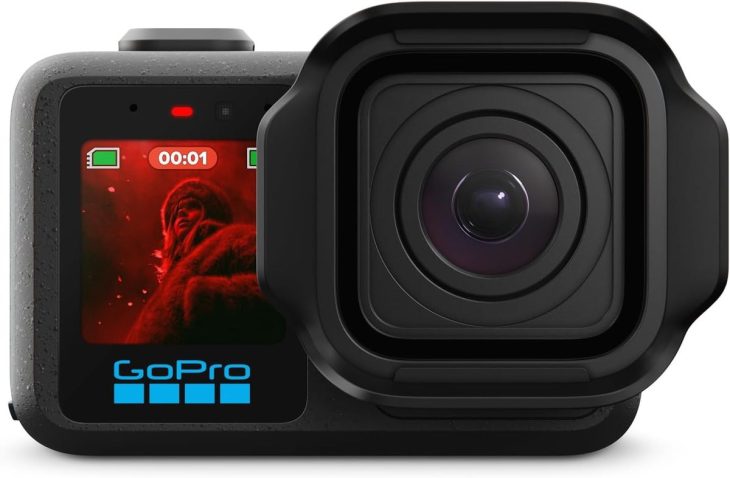
GoPro spent fifteen years making the same camera better. The Mission 1 Pro is the first time in a long while that it has made a genuinely different one. Inside a body you can still throw in a river is a 50-megapixel 1-inch sensor — roughly four times the surface area of the sensors GoPro has shipped for a decade — driven by a new GP3 processor that pushes 8K at 60 frames per second and 1080p at 960. GoPro is calling it a compact cinema camera rather than an action camera, and for once that is not just marketing. At $599 on Amazon against a $699.99 list price, it is also the most expensive standalone camera GoPro has ever asked people to buy.
Reviews Universe is reader-supported. When you buy through links on our site, we may earn an affiliate commission at no extra cost to you.
The Short Version
Rating: 9.0/10
Best for: Filmmakers and creators who want cinema-grade footage from a camera they can mount anywhere and get wet
Price: $599 on Amazon ($699.99 list)
Verdict: The biggest leap GoPro has made in a decade. The 1-inch 50-megapixel sensor transforms low-light performance and grading latitude, and 8K60 with open gate capture puts it in genuinely professional territory. It is no longer a cheap camera, and casual users are better served by the standard Mission 1.
GoPro Mission 1 Pro Overview
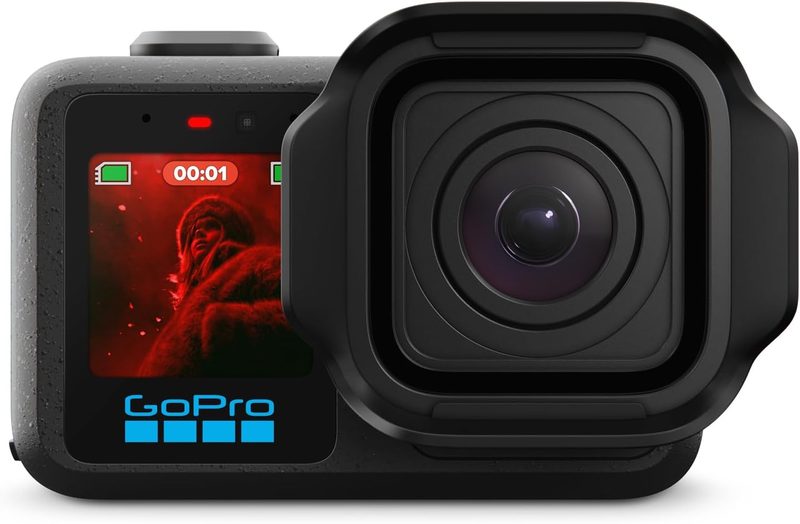
The Mission 1 series arrived on May 28, 2026 and split GoPro’s lineup into three tiers for the first time. The standard Mission 1 lists at $599.99, the Mission 1 Pro reviewed here at $699.99, and the Mission 1 Pro ILS — an interchangeable lens version with a Micro Four Thirds mount — at $699.99 with availability in the third quarter of 2026. All three share the same core hardware: a 50-megapixel 1-inch type sensor and GoPro’s new GP3 processor.
That sensor is the whole story. GoPro action cameras have historically used small sensors, which is why they look superb in bright sun and fall apart the moment light drops. A 1-inch sensor gathers dramatically more light per pixel, which means usable footage at dusk, indoors, and underwater where previous GoPro cameras produced noisy mush. It also means far more latitude when you grade the footage afterwards, because there is real information in the shadows to recover.
The GP3 processor is what makes that sensor usable at speed. GoPro describes it as ultra-power-efficient, and the frame rates back that up: 8K at 60 frames per second, 4K at 240, and 1080p at 960 for extreme slow motion, all in the 16:9 aspect ratio. Photos are 50 megapixels with RAW capture. And the camera remains waterproof to 66 feet with no housing at all — the part of the GoPro formula nobody wanted changed.
GoPro Mission 1 Pro Specs Compared
| Mission 1 Pro | Mission 1 (standard) | Mission 1 Pro ILS | |
|---|---|---|---|
| Price (list) | $699.99 | $599.99 | $699.99 |
| Price on Amazon | About $599 | Varies | Varies |
| Released | May 28, 2026 | May 28, 2026 | Q3 2026 |
| Sensor | 50 MP 1-inch type | 50 MP 1-inch type | 50 MP 1-inch type |
| Processor | GoPro GP3 | GoPro GP3 | GoPro GP3 |
| Max video (16:9) | 8K60 | 8K30 | 8K60 |
| High frame rate 4K | 4K240 | 4K120 | 4K240 |
| Slow motion 1080p | 1080p960 | 1080p240 | 1080p960 |
| Open gate (4:3) | 8K30 and 4K120 | 4K120 only | 8K30 and 4K120 |
| Photo | 50 MP with RAW | 50 MP | 50 MP with RAW |
| Lens | Fixed | Fixed | Micro Four Thirds mount |
| Stabilization | HyperSmooth | HyperSmooth | HyperSmooth with prime lenses |
| Waterproof | 66 feet, no housing | 66 feet, no housing | Not equivalent (lens mount) |
| Battery | Enduro 2 | Enduro 2 | Enduro 2 |
| External audio | Via Media Mod accessory | Via Media Mod accessory | Via Media Mod accessory |
Design and Build
The physical proposition has not changed, and that is deliberate. The Mission 1 Pro is waterproof to 66 feet straight out of the box with no housing, so it still goes surfing, diving, and skiing without a second thought. GoPro’s entire mounting ecosystem — the chest harnesses, helmet mounts, suction cups, and clamps accumulated over a decade — still fits. Whatever else has changed inside, this remains a camera you can bolt to a motorcycle.
Power comes from the Enduro 2 battery, GoPro’s cold-weather-tolerant cell, which matters because 8K60 capture is demanding and cold kills battery capacity. Anyone shooting winter sports should budget for spares regardless; high-resolution, high-frame-rate recording drains any battery of this size quickly.
Audio is the notable omission. The built-in microphone is adequate for reference sound and wind noise, which is what most action footage needs, but serious audio requires the Media Mod accessory to add a microphone input. For a camera positioning itself as cinema equipment, having external audio live behind a paid accessory is a real cost to factor in.
The Grip Edition bundle at $679.99 packages the camera with a point-and-shoot grip and an extra Enduro 2 battery. If you plan to shoot handheld rather than mounted — vlogging, travel, walk-and-talk — that grip fundamentally changes how the camera handles, and the bundle is better value than buying the pieces separately.
Image Quality and Performance
The 1-Inch Sensor Changes Everything
Sensor size is the single most important specification in any camera, and GoPro quadrupling its sensor area is the most consequential thing this camera does. In practical terms: footage shot an hour after sunset is usable rather than a noisy mess. Interior shots without supplementary lighting hold detail. Underwater footage, where light falls off fast with depth, retains color and texture that previous GoPro cameras simply could not record. The camera is explicitly marketed on advanced low light performance, and that claim holds up because the physics supports it.
The second benefit is grading latitude. A larger sensor captures more dynamic range, which means when you pull up the shadows or recover a blown-out sky in post-production, there is actual data there instead of noise and clipping. If you cut your footage in DaVinci Resolve or Adobe Premiere Pro and care how it looks after grading, this is where you will feel the upgrade most.
Frame Rates and Open Gate
8K at 60 frames per second is the headline, and it is genuinely useful beyond bragging rights: shoot 8K and you can crop, reframe, and stabilize aggressively in post while still delivering a clean 4K master. 4K at 240 frames per second gives you eight-times slow motion at delivery resolution. And 1080p at 960 frames per second is extreme slow motion — the kind that turns a splash or an impact into something you can study frame by frame.
Open gate is the specification working filmmakers will care about most. Instead of cropping to 16:9, the camera reads the full 4:3 sensor area, at 8K30 or 4K120 on the Pro. That gives you the entire frame to work with, so you can crop a vertical 9:16 version for social platforms and a horizontal 16:9 version for YouTube from a single take without losing resolution on either. The standard Mission 1 is limited to 4K120 open gate, making this one of the clearest reasons to step up to the Pro.
Stabilization
HyperSmooth remains the best-in-class electronic stabilization it has been for several generations, smoothing handheld and mounted footage to something close to gimbal quality. It is worth understanding that stabilization crops into the frame to work — another reason shooting at 8K and delivering at 4K is the smart workflow with this camera.
Pros and Cons
Pros
- 50-megapixel 1-inch sensor — roughly four times the area of previous GoPro sensors
- Genuinely usable low light performance for the first time in an action camera
- 8K60, 4K240, and 1080p960 video from the new GP3 processor
- Open gate capture at 8K30 and 4K120 for vertical and horizontal delivery from one take
- Substantial grading latitude for colour work in post-production
- Still waterproof to 66 feet with no housing required
- Works with GoPro’s entire existing mounting ecosystem
- 50-megapixel photos with RAW capture
Cons
- $699.99 list price is the most GoPro has asked for a standalone camera
- External audio requires the separately sold Media Mod accessory
- 8K60 recording is demanding on battery — spares are close to mandatory
- High-resolution footage requires a capable computer to edit smoothly
- Overkill for casual users, who are better served by the standard Mission 1
- Large files consume storage and fast memory cards quickly
Who Should Buy the Mission 1 Pro
Buy it if you shoot for delivery. If your footage ends up on a client timeline, a YouTube channel you monetize, or a project you grade properly, the combination of a 1-inch sensor, 8K60, and open gate capture is a legitimate production tool in a body you can mount to anything. Nothing else offers that combination at this size.
Buy it if you shoot in difficult light. Diving, caving, night riding, indoor sports, dusk and dawn — these are the conditions where every previous GoPro disappointed and where this one does not.
Buy the standard Mission 1 instead if you are documenting rather than filming. Family holidays, ski trips, mountain biking clips for friends: the $599.99 Mission 1 has the same 50-megapixel 1-inch sensor and the same GP3 processor. You give up 8K60, 4K240, 1080p960, and 8K open gate — specifications that matter enormously in an edit suite and not at all if you are posting clips straight to your phone.
Wait for the Pro ILS if you want lenses. At the same $699.99 list price, the ILS swaps the fixed lens for a Micro Four Thirds mount, which opens up depth-of-field control and focal length choice that no fixed-lens action camera can match. It is the more interesting camera for controlled shoots, though it necessarily gives up the throw-it-anywhere ruggedness.
Alternatives to Consider
GoPro Mission 1 Pro Grip Edition ($679.99) — The same camera bundled with a point-and-shoot grip and an extra Enduro 2 battery. If you shoot handheld more than you shoot mounted, this is the version to buy.
GoPro Mission 1 Pro ILS — The interchangeable lens model with a Micro Four Thirds mount, at the same $699.99 list price. HyperSmooth stabilization works with prime lenses. The right choice for controlled filmmaking rather than action mounting.
Frequently Asked Questions
Is the GoPro Mission 1 Pro worth the price over the standard Mission 1?
It depends entirely on whether you edit your footage. Both cameras share the same 50-megapixel 1-inch sensor and GP3 processor, so image quality in good light is comparable. The Pro adds 8K60 instead of 8K30, 4K240 instead of 4K120, 1080p960 slow motion instead of 1080p240, and 8K open gate capture. Those are editing-room advantages. If you post clips straight from your phone, save the money and buy the standard Mission 1.
What does open gate mean on the GoPro Mission 1 Pro?
Open gate means the camera records the full 4:3 sensor area rather than cropping to a 16:9 widescreen frame. The practical benefit is that you can produce a vertical 9:16 crop for social platforms and a horizontal 16:9 version for YouTube from the same single take, without either version losing resolution. The Mission 1 Pro shoots open gate at 8K30 and 4K120; the standard Mission 1 is limited to 4K120.
How good is the GoPro Mission 1 Pro in low light?
Dramatically better than any previous GoPro. The 1-inch type sensor has roughly four times the surface area of the sensors in earlier models, which means each pixel gathers substantially more light. Footage shot at dusk, indoors, or underwater at depth is usable rather than noisy. This is the single biggest practical improvement in the camera and the main reason to upgrade from an older GoPro.
Is the GoPro Mission 1 Pro waterproof without a case?
Yes. The Mission 1 Pro is waterproof to 66 feet with no external housing required, in line with GoPro’s long-standing design. It works with GoPro’s full existing range of mounts and accessories, so any harnesses, helmet mounts, or clamps you already own will fit. The Mission 1 Pro ILS with its Micro Four Thirds lens mount does not offer equivalent waterproofing.
Do you need a special memory card for 8K60 video?
Yes. Recording 8K at 60 frames per second produces a very high sustained data rate, and a slow card will cause dropped frames or recording failures. Use a high-endurance card rated for sustained high-bitrate video capture, and expect to fill it quickly — 8K footage consumes storage far faster than 4K. Budget for both fast cards and plenty of capacity.
Can you connect an external microphone to the Mission 1 Pro?
Not directly. The camera has an integrated microphone that handles reference audio adequately, but adding an external microphone requires GoPro’s Media Mod accessory, sold separately. For a camera aimed at filmmakers this is a genuine limitation, and the cost of the Media Mod should be factored into your budget if audio quality matters to your projects.
Final Verdict
The GoPro Mission 1 Pro is the most significant camera GoPro has released in a decade, and it earns the “compact cinema camera” label rather than just wearing it. Moving to a 50-megapixel 1-inch sensor fixed the one weakness that has defined action cameras since the category began — low light — and the GP3 processor turns that sensor into 8K60, 4K240, and open gate capture that survives a professional edit and grade. At $599 on Amazon against a $699.99 list price, it is expensive by GoPro standards and fairly priced by camera standards.
The reservations are practical rather than fundamental. External audio lives behind a paid accessory. The battery drains fast at high resolutions. The files demand fast cards and a capable editing machine. None of this is disqualifying for the audience this camera targets, but all of it adds to the real cost of ownership.
Rated 9.0 out of 10. If you produce video seriously, this is an easy recommendation. If you are capturing memories rather than making films, the standard Mission 1 gives you the same transformative sensor for $100 less.