
Spending $1,400 or more on a robot vacuum used to be indefensible. In 2026 it is merely expensive, because the machines at the top of the market have stopped being vacuums that occasionally push a wet rag around and started being genuinely capable floor-cleaning appliances. The two most interesting are the Roborock Saros 20 at $1,389.99 and the eufy Omni S2 at $1,599.99. They take opposite approaches to the same problem: Roborock built the better vacuum, and eufy built the better mop. We compared both on suction, mopping, navigation, dock automation, and value to work out which one deserves your money.
Reviews Universe is reader-supported. When you buy through links on our site, we may earn an affiliate commission at no extra cost to you.
Quick Verdict
Winner for most homes: the Roborock Saros 20 at $1,389.99. It vacuums harder, climbs higher, fits under more furniture, washes its mops hotter, and costs $210 less.
Buy the Roborock Saros 20 if your home has carpet, pets, thresholds between rooms, or low-clearance furniture — and if you want the strongest all-round cleaner for the lower price.
Buy the eufy Omni S2 if your floors are mostly hard surface and mopping is the job you actually care about. Its HydroJet 2.0 roller mop with automatic detergent dosing is the best robotic mopping system currently sold, and nothing Roborock makes matches it on wet cleaning.
Roborock Saros 20 vs eufy Omni S2: Specs Compared
| Roborock Saros 20 | eufy Omni S2 | |
|---|---|---|
| Price | $1,389.99 | $1,599.99 |
| Suction | 36,000 pascals | 30,000 pascals |
| Mopping system | Dual spinning pads | HydroJet 2.0 self-cleaning roller mop |
| Mop spin speed | 200 revolutions per minute | 240 revolutions per minute |
| Mop downward pressure | Up to 13 newtons | 15 newtons |
| Navigation | StarSight 2.0 solid-state lidar with 3D time-of-flight | Camera and sensor obstacle avoidance |
| Obstacle avoidance | 300+ recognized objects | Perfect 24 out of 24 in independent testing |
| Height | 3.14 in (79.8 mm) – no laser turret | Standard height with turret |
| Threshold climbing | 3.46 in double-layer with AdaptiLift 3.0 | Standard single threshold |
| Carpet mop lift | Lifts pads clear of carpet | 28 mm lift |
| Dock mop washing | 212 degrees Fahrenheit (100 C) hot water | 140 degrees Fahrenheit water wash |
| Dock mop drying | Hot air drying | 131 degrees Fahrenheit hot air |
| Automatic detergent | No | Yes, auto-dispensed from dock |
| Water treatment | Standard clean water | Electrolyzed water for sterilization |
| Debris storage | Self-emptying dock | Up to 68 days |
| Anti-tangle brush | DuoDivide – perfect tangle test score | DuoSpiral – perfect tangle test score |
| Embedded sand on carpet | 89% removed | 87% removed |
| Flattened pet hair on carpet | 88% removed | Over 88% removed |
Roborock Saros 20 — The Better Vacuum ($1,389.99)
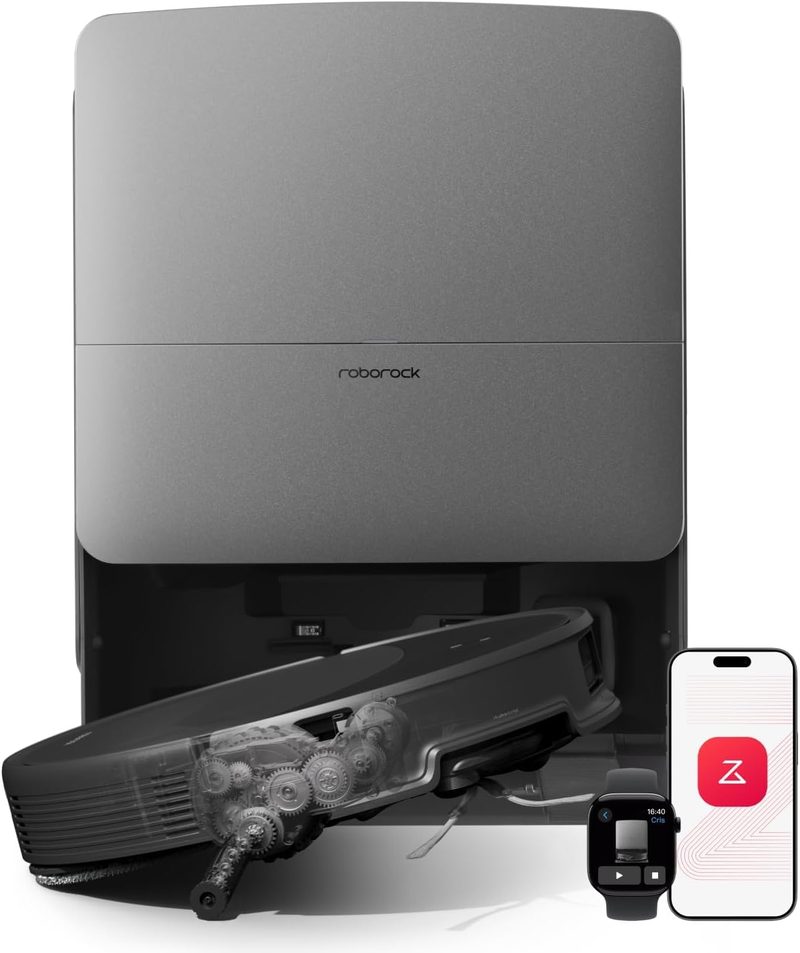
The Saros 20 is Roborock’s 2026 flagship and it leads with raw power: 36,000 pascals of suction, currently among the highest ratings on the market and a substantial jump from the 22,000 pascals of the Saros 10R it replaces. In independent deep-clean testing that translated into 89% of embedded sand pulled out of carpet and 88% of flattened pet hair lifted — and a perfect 100% score on coffee grounds, a result only a handful of robot vacuums have ever managed.
The more interesting engineering is underneath. Roborock removed the spinning laser turret that sticks out of the top of most robot vacuums and replaced it with StarSight 2.0, a solid-state lidar system paired with 3D time-of-flight sensors. Losing the turret drops the robot’s height to 79.8 mm — just over 3.14 inches — which is the difference between cleaning under your sofa and bumping against it. If you have low-clearance furniture, this alone may decide the comparison.
The AdaptiLift 3.0 chassis is the other standout. The Saros 20 climbs double-layer thresholds up to 3.46 inches, which covers the raised door sills, transition strips, and step-downs that strand most robots in a single room. It also handles carpet up to 1.18 inches deep. For multi-level open-plan homes with mixed flooring, this is the most capable chassis available.
Mopping is competent rather than exceptional: dual spinning pads at 200 revolutions per minute with adaptive pressure up to 13 newtons, delivering above-average stain removal while using less water than most rivals. The dock washes those pads in 212 degree Fahrenheit water — boiling point, up from 167 degrees on the previous generation — then dries them with hot air. On hygiene of the mop itself, Roborock wins outright.
Pros
- 36,000 pascals of suction, among the highest available in 2026
- 89% embedded sand removal and a perfect coffee grounds score in testing
- Only 79.8 mm tall thanks to turret-free StarSight 2.0 solid-state lidar
- Climbs 3.46 inch double-layer thresholds with AdaptiLift 3.0
- Mop pads washed at 212 degrees Fahrenheit — the hottest wash of any dock
- DuoDivide anti-tangle brush scored perfectly on the 7-inch hair test
- $210 cheaper than the eufy Omni S2
Cons
- Dual spinning pad mop is less effective than a roller mop on dried stains
- No automatic detergent dispensing
- Mop pressure of 13 newtons trails the eufy’s 15 newtons
- Still a $1,389.99 appliance — deep into diminishing returns territory
- Solid-state navigation is newer technology with a shorter reliability record
eufy Omni S2 — The Better Mop ($1,599.99)
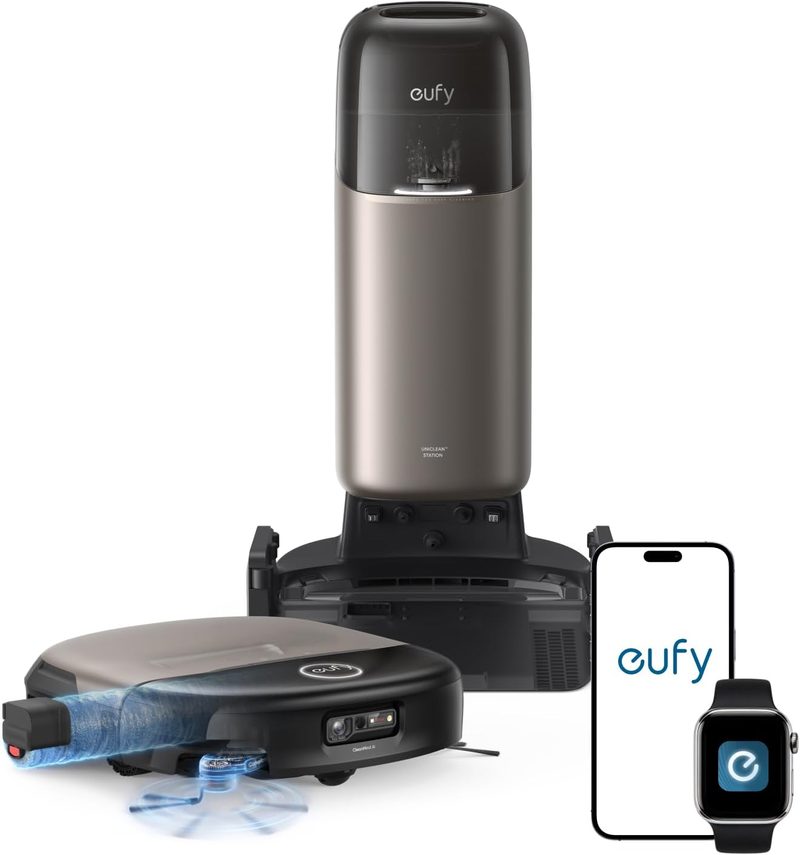
Anker’s eufy division took the opposite bet with the Omni S2: accept slightly less suction, and build the best robotic mop anyone has made. The HydroJet 2.0 self-cleaning roller mop is the centerpiece. Instead of two small spinning discs, it uses a full-width roller that spins at 240 revolutions per minute under 15 newtons of downward pressure — up from 170 revolutions and 10 newtons on the previous S1 Pro. A roller mop scrubs in a way spinning pads simply cannot, and on dried-on kitchen spills the difference is not subtle.
What makes it self-cleaning is a two-scraper structure with 32 water injection ports that rinse the roller continuously as it works. This matters more than it sounds: a conventional robot mop gets progressively dirtier as it cleans, so the last room gets mopped with the first room’s dirt. The Omni S2 is rinsing in real time, meaning the water hitting your floor at the end of a run is close to as clean as at the start.
The Uniclean dock then adds two things Roborock does not offer. It dispenses detergent automatically, so you are not mopping with plain water. And it starts with electrolyzed water for sterilization, which is how eufy supports its 99.99% germ removal claim. The dock washes the roller at 140 degrees Fahrenheit, dries it with 131 degree hot air, fast charges the robot, and holds up to 68 days of debris — meaning you empty it roughly six times a year.
The vacuum side is no slouch. AeroTurbo 2.0 delivers 30,000 pascals with a DuoSpiral split main brush and an extending side brush, and it removed 87% of embedded sand from carpet in testing — a huge improvement over the 61% managed by the S1 it replaces, and within two points of the Roborock. Obstacle avoidance was flawless, scoring a perfect 24 out of 24 across both standard and deliberately difficult torture tests. Over carpet the roller mop lifts 28 mm to keep it dry.
Pros
- HydroJet 2.0 roller mop is the best robotic mopping system currently sold
- 240 revolutions per minute at 15 newtons of pressure, with 32 real-time rinse ports
- Automatic detergent dispensing from the Uniclean dock
- Electrolyzed water sterilization supporting a 99.99% germ removal claim
- Perfect 24 out of 24 obstacle avoidance score, including torture tests
- Dock stores up to 68 days of debris — empty it about six times a year
- 30,000 pascals and 87% embedded sand removal, a huge jump over the S1
Cons
- $1,599.99 makes it the most expensive option here by $210
- 30,000 pascals trails the Roborock’s 36,000
- Taller than the Saros 20, so it fits under less furniture
- Mop washed at 140 degrees Fahrenheit, far cooler than Roborock’s 212 degrees
- No equivalent to AdaptiLift 3.0 for tall double-layer thresholds
- Roller mop and detergent are ongoing consumable costs
Head-to-Head: Where They Actually Differ
Vacuuming: Roborock, Narrowly
On paper it is 36,000 pascals against 30,000, but suction ratings are marketing numbers and the testing results are much closer than the gap suggests. The Saros 20 removed 89% of embedded sand from carpet; the Omni S2 removed 87%. Both lifted about 88% of flattened pet hair. Both anti-tangle brush designs — Roborock’s DuoDivide and eufy’s DuoSpiral — scored perfectly on hair wrap tests, which is genuinely notable if you have long hair or a shedding dog. Roborock wins, but by two percentage points, not by the 20% its suction rating implies.
Mopping: eufy, Decisively
This is not close. A roller mop spinning at 240 revolutions per minute under 15 newtons of pressure, rinsed continuously through 32 water ports and fed automatically dosed detergent, is a fundamentally better cleaning mechanism than two pads spinning at 200 revolutions with plain water. If you have a tile kitchen, hardwood throughout, or small children who treat the floor as a plate, the Omni S2 will visibly outperform the Saros 20 on wet cleaning. Roborock’s counter-argument is that it washes its own mops at 212 degrees Fahrenheit versus eufy’s 140 — so Roborock’s mop ends up more sanitary, while eufy’s mop cleans your floor better.
Navigation and Obstacle Avoidance: A Split Decision
The eufy Omni S2 posted a perfect 24 out of 24 obstacle avoidance score in independent testing, including deliberately difficult torture tests — the best result available. The Saros 20 recognizes over 300 object types and performs very well, but eufy takes this category. Roborock’s advantage is elsewhere: by dropping the laser turret for solid-state lidar, the Saros 20 stands only 79.8 mm tall and slides under furniture that stops the eufy at the edge. Which matters more depends entirely on whether your problem is clutter on the floor or clearance above it.
Getting Around the House: Roborock, Clearly
AdaptiLift 3.0 climbs 3.46 inch double-layer thresholds. That is a genuinely uncommon capability and it is the single most practical advantage in this comparison for anyone living in an older home with raised door sills, or a house with step-downs between rooms. A robot vacuum that cannot leave the room it started in is an expensive room cleaner. The Saros 20 goes places the Omni S2 cannot.
Dock and Maintenance: eufy, On Convenience
The Uniclean dock’s 68 days of debris storage means about six emptyings a year, and automatic detergent dosing removes another chore. Roborock’s dock self-empties and washes hotter, but you are still adding any cleaning solution yourself. eufy’s system asks less of you day to day — at the cost of ongoing consumables in detergent and roller replacements.
Price and Value: Roborock
At $1,389.99 against $1,599.99, Roborock delivers more vacuum, more mobility, and a lower profile for $210 less. eufy is charging a premium specifically for its mopping system and dock automation. That premium is defensible if mopping is the reason you are buying a robot at all. If you want the best general-purpose machine, the cheaper one is also the better one — which does not happen often.
Frequently Asked Questions
Is the Roborock Saros 20 or the eufy Omni S2 better?
The Roborock Saros 20 is the better choice for most homes. It has stronger suction at 36,000 pascals, climbs 3.46 inch thresholds that would strand the eufy, stands only 79.8 mm tall so it fits under more furniture, and costs $210 less. The eufy Omni S2 is the better choice specifically if mopping matters more than vacuuming, because its HydroJet 2.0 roller mop with automatic detergent dosing is the best robotic mopping system currently available.
Does more suction actually mean better cleaning in robot vacuums?
Not proportionally. The Saros 20 is rated at 36,000 pascals and the Omni S2 at 30,000, a 20% difference on paper, but in independent deep-clean testing they removed 89% and 87% of embedded carpet sand respectively — a two point gap. Brush design, mop pressure, and navigation affect real-world results at least as much as the headline suction number, which is largely a marketing specification.
What is a roller mop and is it better than spinning pads?
A roller mop is a single full-width cylinder that rotates against the floor, like a miniature version of a commercial floor scrubber. Spinning pads are two small discs that rotate flat against the surface. The roller applies more consistent pressure across its width and scrubs rather than wipes, which makes it noticeably better on dried-on stains. The eufy Omni S2 uses a roller at 15 newtons of pressure; the Roborock Saros 20 uses spinning pads at up to 13 newtons.
How often do you have to empty these robot vacuums?
The eufy Omni S2 dock stores up to 68 days of debris, which works out to roughly six emptyings per year. The Roborock Saros 20 also self-empties into its dock. In both cases the practical maintenance is emptying the dust bag every couple of months, refilling clean water, emptying dirty water, and periodically replacing consumables like mop pads or the roller.
Can a robot vacuum climb over thresholds between rooms?
The Roborock Saros 20 can, and this is one of its strongest advantages. Its AdaptiLift 3.0 chassis climbs double-layer thresholds up to 3.46 inches, covering the raised door sills and transition strips found in most older homes. The eufy Omni S2 handles standard single thresholds but does not match that capability. If your home has tall thresholds between rooms, this should heavily influence your choice.
Are $1,400 robot vacuums worth it compared to $500 models?
Only for specific situations. The genuine advantages at this price are threshold climbing, self-washing and self-drying mop docks, long-term debris storage, and mopping systems that actually scrub. If you have hard floors you want mopped properly, pets, thresholds between rooms, or low furniture, the premium buys real capability. If you have a single-level carpeted apartment and mainly want dust picked up, a $400 to $600 model captures most of the value — the $300 to $1,000 range is where robot vacuum value peaks in 2026.
Final Verdict: Which One Should You Buy?
Buy the Roborock Saros 20 at $1,389.99. It is the better robot for the larger number of homes and it is the cheaper of the two, which is an unusual combination. The 36,000 pascal suction leads the category, the 79.8 mm turret-free body reaches under furniture that stops everything else, and AdaptiLift 3.0 threshold climbing means it actually cleans your whole home rather than one room of it. Its mopping is good; it just is not the best here.
Buy the eufy Omni S2 at $1,599.99 if you are buying a robot primarily to mop. Hard floors throughout, a tile kitchen that takes a beating, young children, sticky spills — these are the conditions where the HydroJet 2.0 roller mop, the automatic detergent dosing, and the electrolyzed water sterilization justify the extra $210 and the slightly lower suction. Its perfect obstacle avoidance score is a genuine bonus if your floors are cluttered.
One practical tiebreaker: measure the clearance under your sofa and the height of the thresholds between your rooms before you order. Those two numbers will settle this comparison faster than any specification sheet.
Also worth a look: the Roborock Saros 20 Sonic ($1,499.99) adds sonic mop vibration, and the Roborock Qrevo S Pro ($429.99) covers most of the basics for under a third of the price.