

Most music distributors want money before your song is even on Spotify: a yearly subscription, a fee per release, or both. RouteNote is the major exception. Its Free plan sends your music to Spotify, Apple Music, TikTok, YouTube Music, Amazon and dozens of other stores for nothing, keeps it there for as long as you like, and simply takes 15% of what it earns. If you’d rather keep 100%, you can pay a small one-off Premium fee for any individual release. We’ve used RouteNote’s free plan ourselves; this review covers how it works in 2026, what it costs, how long releases really take and whether it’s the right distributor for you.
Reviews Universe is reader-supported. When you buy through links on our site, we may earn an affiliate commission at no extra cost to you.
The Short Version
Rating: 8.2/10
Best for: New and independent artists, hobbyists and anyone who doesn’t want to pay a yearly fee to keep their music online
Price: Free (you keep 85%); Premium from $10 per release (you keep 100%)
Verdict: The best free music distributor. No upfront cost, no subscription, no takedown if you stop paying, and free YouTube Content ID. The catch is time: reviews currently take over five weeks on the Free plan, so plan releases well ahead.
What Is RouteNote?
RouteNote is a digital music distributor founded in 2007 in Cornwall, England, and still run from Truro by its British founders. It calls itself the leading digital music distributor in Europe and says it has more than three million users and 13.9 million tracks. Besides distribution it offers RouteNote Publishing for songwriter royalties, SoundCloud monetisation, YouTube and social media rights management, and PUSH.fm promotion tools.
Like most distributors it is non-exclusive: you keep 100% of the rights to your recordings, and you can use other distributors or sign to a label at the same time.
Free vs Premium: How RouteNote Pricing Works
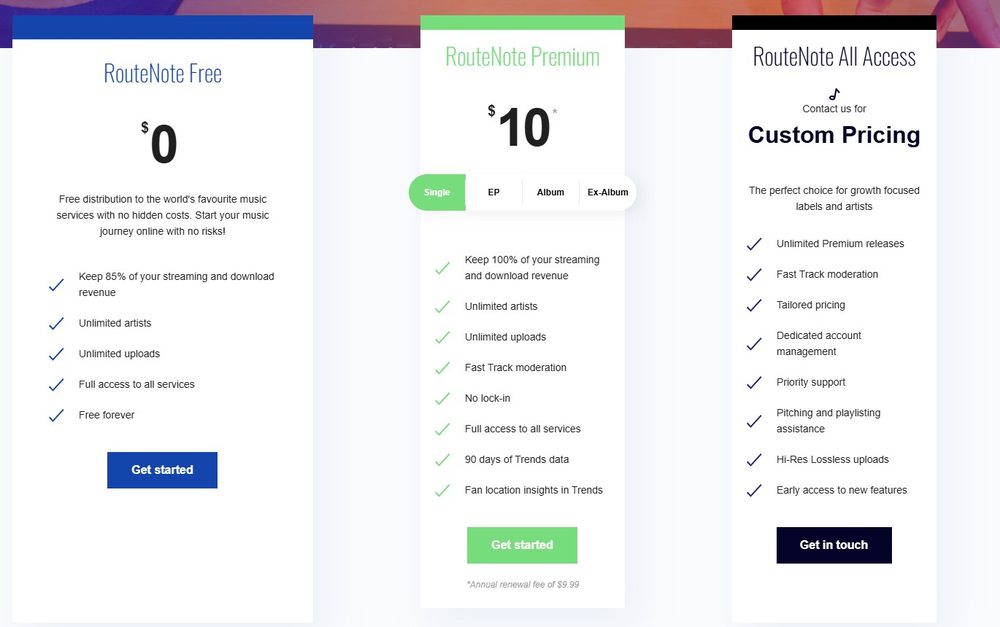
RouteNote lets you choose a plan for each release rather than for your whole account.
| RouteNote Free | RouteNote Premium | |
|---|---|---|
| Upfront cost | $0 | $10 single, $20 EP, $30 album, $45 for 19+ tracks |
| Yearly cost | $0, forever | $9.99 per release from year two (optional) |
| You keep | 85% of revenue | 100% of revenue |
| Moderation | Standard queue | Fast Track moderation |
| Stores, Content ID, analytics | All included | All included, plus 90-day Trends and fan locations |
| Artists and uploads | Unlimited | Unlimited |
| If you stop paying | Nothing to stop | Release moves to Free and stays live |
Free really is free: no upload fees, no yearly fee and no charge to keep your music online. RouteNote earns its money by keeping 15% of the revenue it receives for your music. Premium is a one-off fee per release; after the first year, a $9.99 yearly fee keeps it on Premium, and if you don’t pay it the release simply moves to Free. Payment is taken only once the release is approved, with a 30-day refund window, and you can switch any release between Free and Premium later.
Which should you choose? Premium pays for itself once a single earns more than about $67 a year (15% of $67 is roughly the $10 fee, or the $9.99 renewal). Most new releases earn less than that, so start on Free, and upgrade the releases that take off — or use Premium when you need a release out on a set date.
Labels can ask about All Access, with custom pricing, unlimited Premium releases, priority support, account management and pitching help.
How Long Does RouteNote Take?
This is RouteNote’s weak spot. Every release is checked by a human moderation team before it is sent out, and on October 12, 2026 RouteNote’s support page said moderation was taking 26-27 working days — just over five weeks — because of a high volume of submissions. Releases with AI-generated or AI-assisted content may take longer. Once approved, RouteNote sends the release to stores within 24 hours, and it can take 7-14 days to appear everywhere.
Two ways to deal with it: upload six to eight weeks before you want the song out and set that release date, or choose Premium, which RouteNote’s pricing page lists with Fast Track moderation. Getting the release right first time also matters, because a release sent back for changes loses more time.
Tips to Get Approved First Time
- Follow the style guide. Use correct capitalisation and artist names, avoid generic titles such as “Track 1”, and keep contact details and promotional text out of your metadata.
- Check your audio. RouteNote rejects clipping, hum or hiss, heavy distortion, audio that is far too quiet or loud, and more than eight seconds of silence at the start or end.
- License your covers. Covers can go to Spotify, Deezer, Tidal and several other stores without a licence; for the rest you need a mechanical licence or must exclude the US, Canada, Mexico, India and Pakistan.
- Be upfront about AI. RouteNote accepts some AI-generated music but won’t deliver it to Amazon, Korean stores or content-recognition platforms, and may ask which tools you used. Don’t credit the AI company or imitate real artists.
Stores and Features
RouteNote delivers to the services that matter: Spotify, Apple Music and iTunes (including Shazam), Amazon Music, YouTube Music, TikTok, Instagram and Facebook, Deezer, Tidal, Pandora, iHeartRadio, SoundCloud, Boomplay, Anghami, JioSaavn, Qobuz, Tencent’s QQ Music, Kugou and Kuwo, NetEase, Korea’s Melon and a bundle of around 40 Chinese services. New stores are added to your releases automatically at no extra cost.
Features that rival distributors often charge extra for are included on both plans:
- YouTube Content ID and content recognition on Facebook, Instagram and TikTok, free
- SoundCloud monetisation through RouteNote’s network
- Revenue splits with collaborators who have RouteNote accounts
- PUSH.fm smart links and pre-saves, and Spotify for Artists profile claims
- Trends analytics for Spotify and Apple Music (longer history on Premium)
- An iOS app for uploading releases and checking stats, and the Luna AI support assistant
What’s missing compared with DistroKid: there’s no built-in cover-song licensing (RouteNote points you to a $12-per-song licensing service), no mastering-on-upload subscription and no guaranteed fast release on the Free plan.
Payouts and Leaving
RouteNote pays monthly, between the 15th and 20th, once your balance reaches $50, by PayPal or bank transfer through Wise. Most stores report earnings about 45 days after the month they were earned, so expect your first money roughly two to three months after release. A transaction fee may apply. If you close your account, RouteNote pays out your balance even if it’s under $50.
There’s no lock-in. You can take a release down from every store, or from individual stores, at any time for free (it takes about 7-14 days), and move to another distributor by re-uploading the same audio and metadata with the same ISRC codes. Unlike subscription distributors, though, you never have to: on the Free plan your music stays online indefinitely without paying anything.
Reputation and Support
RouteNote’s Trustpilot score is a mixed 3.2 out of 5 from about 3,000 reviews (October 2026): more than half are five stars, praising free distribution and helpful support, while a quarter are one star, mostly about long moderation waits, slow replies and rejected releases. RouteNote replies to most negative reviews. Its own support page says ticket replies currently take around 8-10 working days, so the help center and the Luna assistant are the fastest way to get answers.
That matches our view: RouteNote is reliable and honest about what it charges, but it isn’t fast. Artists who need hands-on support or quick turnarounds should consider Premium or a subscription distributor.
RouteNote vs DistroKid
DistroKid charges $24.99 a year for one artist and lets you keep 100%, with releases live in days. RouteNote Free costs nothing and keeps 15%. The bigger difference is what happens when you stop paying: DistroKid removes your music from stores unless you’ve bought Leave a Legacy for each release ($29 per single, $49 per album), while RouteNote Free never asks you for money to keep it up. If your music earns less than about $167 a year, RouteNote is the cheaper option too. Read our full DistroKid vs RouteNote comparison and our guide to the best DistroKid alternatives.
Pros and Cons
Pros
- Completely free: no upfront, yearly or takedown fees
- Music stays online forever on Free
- Premium per release lets you keep 100%
- Free YouTube Content ID and SoundCloud monetisation
- Unlimited artists and releases
- Switch releases between Free and Premium anytime
- Non-exclusive, no lock-in
Cons
- Moderation takes 5+ weeks on Free (Oct 2026)
- 15% commission on Free
- Slow support replies
- $50 minimum payout
- Mixed Trustpilot reviews
Frequently Asked Questions
Is RouteNote really free?
Yes. RouteNote Free has no upload fees, no subscription and no charge to keep music online. RouteNote keeps 15% of the revenue your music earns and pays you 85%. Premium is optional, from $10 per release, and lets you keep 100%.
Is RouteNote legit and safe?
Yes. RouteNote is a UK company founded in 2007 that distributes to Spotify, Apple Music, Amazon, YouTube Music, TikTok and many other stores, and says it has over three million users. It is non-exclusive, so you keep the rights to your music.
How long does RouteNote take to approve a release?
In October 2026 RouteNote said moderation was taking 26-27 working days, followed by up to 7-14 days for stores to ingest the release. Premium releases get Fast Track moderation. On the Free plan, upload six to eight weeks before your release date.
How much does RouteNote Premium cost?
Premium costs $10 for a single, $20 for an EP, $30 for an album and $45 for releases with 19 or more tracks, paid once. From the second year there is an optional $9.99 yearly fee per release; if you don’t pay it, the release moves to the Free plan and stays live.
What happens to my music if I stop using RouteNote?
On the Free plan nothing happens: your music stays online with no fees. You can take releases down for free at any time, which takes about 7-14 days. Closing your account removes your music from stores and pays out your balance.
When does RouteNote pay?
Monthly, between the 15th and 20th, once you have at least $50, by PayPal or bank transfer via Wise. Most stores report earnings about 45 days after the month they were earned.
Final Verdict
RouteNote is the best free way to get your music on Spotify, Apple Music and the rest. There’s nothing to pay up front, nothing to renew and no risk of your catalog disappearing when a subscription lapses, and YouTube Content ID is included. Premium is a fair, flexible upgrade for the releases that earn the most or need to go out on time.
Rated 8.2 out of 10. The long moderation queue and slow support keep it from a higher score, so it’s not ideal for artists who need music live within days. For everyone else — especially if you’re starting out — it’s where we’d release first.